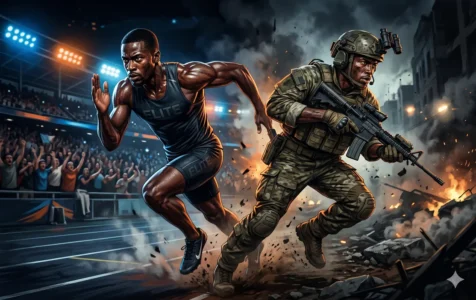

If you watch any pre-match team talk from a male-oriented sport, chances are you will see analogies that draw from the military: the concept of a battle, a war, the need for controlled aggression, to fight for what you want. In Any Given Sunday, Al Pacino’s character Tony D’Amato, head coach of the Miami Sharks football team, delivers a famous pre-game speech using lines such as “the biggest battle of our professional lives,” “we can fight our way back into the light,” and “when we add up all those inches, that’s going to make the difference between winning and losing; between living and dying.” D’Amato’s point is that the players have to fight for every inch of play to be successful, and they need to be relentless in their pursuit of every inch. They will live or die by their efforts.
Fortunately, deaths in the sporting arena are incredibly rare. While we’re typically not in any real danger when we take part in sport, especially track and field, we use the analogy to motivate ourselves and others to perform to a higher level. Historically, sport served as a means of training for war; at the Ancient Olympic Games, it’s easy to see how events such as hoplitodromos (running in armor), wrestling, and spear throwing (which we now might call the javelin) cross over into military conflict. Similarly, in Ancient Rome, gladiatorial combat often blurred the lines between sport and warfare, much like coaches across the world do today with their pre-game speeches.
What Sport Can Learn from the Military
Motivational talks aside, there is a lot that sport can learn from the military. This isn’t a one-way street; the military has long taken ideas from the arena of elite sport. As an example, the US Army is that nation’s largest employer of sport and performance psychologists. The similarities are clear: both sport and combat require high levels of physical preparation, the ability to control emotions under stress and pressure, and the ability to maintain focus to deliver an optimal performance. Success in sport comes in the form of medals, money, and fame; in the military, it often comes in the form of everyone coming home without serious injury. We like to think the stakes are high in sport, but they are far higher in military settings.
Given these raised stakes, the demands on elite soldiers are incredible. They often find themselves in high-stress environments at a moment’s notice, needing to perform at their peak. To even become an elite soldier, they have to endure lengthy selection processes that take them close to, and in many cases past, their physiological and psychological limit. Because of the incredible consequences of failure, and the steps elite soldiers go to in their preparation to avoid failure, there are many lessons that we could take from our military counterparts to better prepare our athletes. That is the key point of a 2015 paper, published in the International Journal of Sports Physiology and Performance and titled “[When Failure Is Not an Option: Creating Excellence in Sport Through Insights From Special Forces](https://journals.humankinetics.com/view/journals/ijspp/10/2/article-p137.xml).” The paper is authored by Shona Halson, a well-established sport and exercise researcher who at the time was based at the Australian Institute of Sport, and Jeffrey Nichols, a former US Navy SEAL. Comparing elite soldiers and elite athletes, they write, may assist us in understanding the characteristics that exemplify excellence.
Cognitive Flexibility: The Trainable Edge
Initial data from the field of neurophysiology (e.g., fMRIs and EEG) suggests there may be similarities in terms of brain function related to cognitive flexibility. Cognitive flexibility is a core executive function that relates to an individual’s ability to adapt their thinking and behavior when the circumstances change. This is similar to the Mike Tyson quote of “everyone has a plan until they get punched in the mouth” (or the military phrase “no plan survives first contact with the enemy”). Cognitive flexibility outlines how, when situations don’t go as planned (a common occurrence), the best performers can stay calm, reframe, and adapt without freezing. Cognitive flexibility aligns with the concept of resilience; flexible thinkers can cope better with adversity because they can change their mental playbook, as opposed to persevering with a failing strategy. Research has shown that world-class athletes are better adapted neurophysiologically than well-trained but not world-class athletes. Researchers have reported similar results in Special Forces soldiers, with research highlighting that Navy SEALs can rapidly shift their focus of attention in response to a stressor.
The good news is that cognitive flexibility can be developed. Within sport, researchers in the skill acquisition and psychology domains have explored this topic, with findings suggesting that pressure training, contextual interference, and training in representative environments may support the development of cognitive flexibility. Within military contexts, aspects such as mindfulness and Acceptance and Commitment Training (ACT, where individuals are encouraged to accept their feelings and still act in accordance with their values, as opposed to taking steps to change how they feel) support the development of cognitive flexibility (or related contributing constructs). The research to date suggests that both elite soldiers and sports people may demonstrate superior brain functioning, and this may in turn explain how these individuals function at a high level in challenging situations, whether in the arena or on the battlefield. As a result, utilizing these methods to enhance cognitive flexibility in the athletes we work with is an important step for a coach to consider.
Choosing People Who Can Handle Chaos
In contrast to the similarities in psychological states and traits, a key difference, as highlighted by Halson and Nichols, is in how elite soldiers and elite athletes are identified and selected. Within sport, we tend to identify (or at least label) athletes as talented through assessments of performance, or performance-related traits such as anthropometrics, physical performance tests, etc. We rarely assess athletes on psychological characteristics, or their ability to function and perform under highly stressful conditions. One exception that I’m aware of is how British Skeleton identifies talented athletes. The program selects athletes based on physiological characteristics (often 30m sprint time and vertical jump height), and then takes the best athletes to a skeleton track and pushes them down. Around half the selected athletes withdraw at this stage, a very stressful one, which allows the staff to quickly determine which athletes are most likely to be capable of withstanding the stresses of the sport. This approach has been very successful, with British athletes winning the 2010, 2014, and 2018 Winter Games, as well as winning silver and bronze medals along the way.
This approach is similar to how elite military units select their soldiers. The UK Special Forces, for example, subject recruits early on to the Aptitude Phase, comprised of four weeks of increasingly difficult loaded marches that require physical fitness and the ability to continue to function while fatigued and uncomfortable. Staff use this stage to identify those unlikely to make it, before subsequent stages train the potential recruits in the key skills they require. Similarly, the US Navy SEALs have a four-week block early on in their selection process that comprises a variety of physical tests, which become progressively harder over time before culminating in Hell Week: five and a half days of continuous training, with each potential recruit limited to a maximum of four hours of sleep across the whole five days. Elite military units utilize these methods to identify those individuals who possess physical and psychological resilience, a willingness to work in a team, a high level of self-confidence, and a strength of character.
While this is perhaps an unsophisticated approach to talent ID, elite military units are very clear on the type of person they want to recruit, and these selection processes appear to be effective at finding these people. Within this, there is a lesson for elite sport: you get the person who you develop, so you need to ensure you’re developing the correct traits. In sport, we need athletes to deliver their best performance under pressure; to do this, we need to find ways to expose them to pressure, as a way of determining whether they currently possess the skills, and then taking time to develop them. This could include scenario-based training (e.g., a simulated rain delay) to see how athletes respond. Similarly, training that utilizes different types of distraction may serve to “stress inoculate” athletes to the sensory overload of high-level competition.
Where the Analogy Ends
A word of caution, however. While I do believe that sport can learn a lot from the military (and vice versa), we need to be clear that there is a level of ethical divergence; the military accepts casualties, but sport should not. A focus on military practice could also drive toxic cultures in sport, although it is worth pointing out that the military is focused on supporting the well-being of their operators, as opposed to the more toxic, macho image of years gone by.
From Analogy to Application: Building Resilient Performance
The military-sport comparison is only useful if it translates to what we actually do on the ground. Otherwise we’re stuck in the motivational speaking troupe of “going to war.” A key learning from the article, from my perspective, is to explore how we design environments in which athletes learn to adapt, stay composed, and deliver under pressure. Just as military training deliberately introduces stress (along with fatigue, discomfort, and uncertainty), athletes can benefit from structured pressure drills. The purpose is not to punish athletes, but to rehearse adaptability when things go wrong, preparing them for chaos.
Elite soldiers are also increasingly likely to utilize methods such as mindfulness and ACT to foster adaptability and perform under pressure. For athletes, these methods change the mindset from attempting to ignore or suppress anxiety to noticing it, accepting it, but still executing.
Military selection processes aim to identify people who can perform when exhausted, when plans go awry, and when the environment turns hostile. Sport rarely tests for these abilities, but it could. Exposing athletes to controlled adversity ([the Rocky Road of performance](https://www.frontiersin.org/journals/psychology/articles/10.3389/fpsyg.2016.01482/full)) helps cultivate the skills required for success. As such, we need more experiences that deliver that, as opposed to seeking to remove stress, anxiety, or discomfort.
Practical Blueprints for Team Sport Coaches
Knowing the theory is one thing, but applying these concepts to your team requires practical implementation. Here are four potential ways that team sport coaches can develop cognitive flexibility and stress resilience in their athletes:
Option 1: The Chaos Circuit (Developing Cognitive Flexibility)
Create a 20-minute training block where the environment constantly changes. Start with your standard drill (e.g., passing pattern in soccer, defensive rotation in basketball), then introduce planned disruptions every 3-4 minutes. Some examples of planned disruptions could be removing a player mid-drill to force the team to adapt and reorganize, changing the objective without stopping play (“now you’re defending the opposite goal”), introducing biased refereeing (a good way to explore whether the athletes can maintain their self-regulation in the face of adversity), or suddenly enforcing unfamiliar rules. The key here is not to announce changes in advance, forcing the athletes to adapt on the fly. Afterwards, run a structured debrief with the players: what did they notice? How quickly did they adapt? What strategies emerged, and how effective were those strategies? Repeating this process on a semi-regular basis allows you to track improvements in adaptation speed and decision-making under uncertainty. To move beyond subjective impression, consider anchoring your tracking to observable behaviors: log how many disruptions occur before the first breakdown in structure; record time-to-reorganization after each planned disruption; or use a simple post-debrief rating scale (e.g., 1-5) across dimensions such as “responded without prompting” or “maintained role clarity after change.” Over a 6-8 week cycle, these data points will reveal whether athletes are genuinely adapting faster or simply getting accustomed to your specific disruptions, a distinction that matters. Video review adds another layer: reviewing short clips in debrief allows athletes to self-assess and helps coaches identify whether improvements are transferring across different drill contexts.
Option 2: Pressure-Graduated Scenarios (Building Stress Inoculation)
Design a progressive stress ladder over a 6-week period, varying the challenge and consequences for underperformance. As an example, week 1 could be a baseline week: execute the game plan in practice with no pressure. In week 2, you could add a consequence, such as a minor forfeit that isn’t demeaning or degrading (one that I’ve used is having to wear silly headwear during the next warm-up). In week 3, experiment with bringing in observers. In my experience, I’ve utilized the Head Coach or Performance Director’s presence to ramp up the pressure. In week 4, play around with introducing a hostile environment, such as having crowd noise or (fake) “opposition fans” heckling. Within this area, I’ve experimented with using air horns as distraction. In week 5, create a must-win scenario with public stakes: you could film it and post it to social media. In week 6, try to combine all elements in a full simulation. This systematically exposes athletes to increasing stressors while giving them tools to perform through the stress. Military units use similar progressive stress exposure in training, allowing them to prepare the nervous systems, not just tactics.
Option 3: The ACT Pre-Competition Protocol (Acceptance and Performance)
Before key matches, experiment with running a 10-minute team session based on ACT principles. This could include:
Step 1 – Have athletes name their pre-game anxiety out loud in pairs (“I’m worried I’ll miss my first pass”).
Step 2 – Acknowledge these feelings are normal and don’t need to disappear (“you can be nervous AND execute”).
Step 3 – Reconnect to team values (“we value trust, effort, and supporting each other—that’s what we control”).
This process shifts the focus from eliminating anxiety to acting consistently with values despite anxiety. Special Forces operators use similar psychological prep before missions. The goal isn’t to force calm; instead, the focus is on committed action under pressure, what we would term performing with pressure.
Option 4: Mapping Outcomes to Measurable Behaviors (Translating Intent into Observable Progress)
Developing cognitive flexibility and stress resilience is only meaningful if you can observe whether the training is working. A critical step is mapping a key outcome onto a concrete behavior, and then systematically checking whether the athlete is performing that behavior as intended. In soccer, for example, teams often talk about “immediate defensive transitions,” a phrase that sounds clear but is actually difficult to act on. By translating this into a specific, observable behavior (within three seconds of the turnover, all outfield players must have begun moving into their defensive shape), it becomes far easier to assess whether the team is making progress, to give meaningful feedback, and to anchor selection conversations in evidence rather than impression. This mirrors how Special Forces units use standardized performance criteria to evaluate readiness: not vague notions of “performing well under pressure,” but specific, observable actions completed within defined conditions. For each training block you design using Options 1-3, identify one or two behaviors that serve as your observable success criteria. These become your data points across weeks and months.
These options aren’t about making training harder for the sake of it. Instead, they’re about deliberately developing the psychological and cognitive capacities that separate good performers from elite ones. The military learned long ago that you can’t wait for a firefight to discover if someone can handle chaos. You can’t wait for the championship game to find out if your team can adapt under pressure. Build these experiences into your training culture systematically, and watch your athletes develop not just as players, but as resilient, adaptable competitors.
The Sports Team as Special Forces Unit
Without wanting to torture the analogy, we can also view sports teams as special forces units. Selection can reflect aspects such as role suitability, stress tolerance, reliable execution under fatigue, noise, and scrutiny, and overall coachability. Culturally, these units obsess over processes: standard operating procedures, drills, scenarios, etc. These units do this not to be rigid, but to instead free the operators to perform under pressure and stress, reducing the overall cognitive load and decision-making processes. It’s crucial that this analogy doesn’t fetishize the warrior culture (taking on aspects such as chest beating and an over-emphasis on toughness), but instead focuses on preparing athletes to effectively perform in chaos. The military also often calls for loyalty; within sport, this needn’t be blind loyalty, but loyalty to the overall vision of the team. In this case, loyalty means calling out sloppy behaviors, or accepting decisions without theatrics, as well as athletes recognizing that they are part of something bigger than themselves.
There are many similarities between elite athletes and elite soldiers. Sport doesn’t need to mimic the battlefield, but it can learn from the way the military systematically builds adaptable, resilient, and values-driven individuals. We already train physical qualities down to the smallest detail, but often the difference between success and failure in elite sport isn’t physically driven. As such, the next step is for us to train adaptability with the same precision we develop athletes physically. In sport, just as in Special Forces, when failure is not an option, the ability to be flexible, refocus, and stay aligned to our values makes all the difference.
References
Halson, S. L., & Nichols, J. (2015). When failure is not an option: Creating excellence in sport through insights from Special Forces. International Journal of Sports Physiology and Performance, 10(2), 137–141. https://journals.humankinetics.com/view/journals/ijspp/10/2/article-p137.xml
Harung, H. S., Travis, F., Pensgaard, A. M., Boes, R., Cook‐Greuter, S., & Daley, K. (2011). Higher psycho‐physiological refinement in world‐class Norwegian athletes: brain measures of performance capacity. Scandinavian Journal of Medicine & Science in Sports, 21(1), 32-41. https://pubmed.ncbi.nlm.nih.gov/19883380/
Nakata, H., Yoshie, M., Miura, A., & Kudo, K. (2010). Characteristics of the athletes’ brain: Evidence from neurophysiology and neuroimaging. Brain Research Reviews, 62(2), 197–211. https://pubmed.ncbi.nlm.nih.gov/19944119/
Simmons, A. N., Fitzpatrick, S., Strigo, I. A., Potterat, E. G., Johnson, D. C., Matthews, S. C., … & Paulus, M. P. (2012). Altered insula activation in anticipation of changing emotional states: neural mechanisms underlying cognitive flexibility in special operations forces personnel. Neuroreport, 23(4), 234-239. https://pubmed.ncbi.nlm.nih.gov/22222502/
Stanley, E. A., & Jha, A. P. (2009). Mind fitness: Improving operational effectiveness and building warrior resilience. Joint Force Quarterly, 55, 144–151.
https://web.archive.org/web/20131202231803/http:/www.mind-fitness-training.org/JFQ_Mind_Fitness.pdf
Collins, D. J., Macnamara, A., & McCarthy, N. (2016). Putting the bumps in the rocky road: Optimizing the pathway to excellence. Frontiers in psychology, 7, 1482. https://www.frontiersin.org/journals/psychology/articles/10.3389/fpsyg.2016.01482/full
The post When Failure Is Not an Option appeared first on SimpliFaster.