
Monitoring, Wearables, and Practical Decision Frameworks
The growing availability of monitoring tools has fundamentally changed how recovery and physiological readiness are discussed in applied settings. Heart rate variability platforms, sleep trackers, Global Positioning Systems, wellness questionnaires, and composite “readiness” scores are now commonplace across nearly all levels of sport. While these tools offer valuable information, their usefulness depends entirely on how coaches interpret and apply the data.
The core mistake is not using monitoring technology. The core mistake is expecting technology to answer questions it was never designed to answer. Monitoring tools do not make decisions. Coaches do, or at least should in most cases. Understanding the distinction between recovery and readiness provides the framework necessary to interpret data without being misled by it, or worse, being blinded by it due to introspective biases.
What Do Most Monitoring Tools Actually Measure?
Most commonly used monitoring tools are far more sensitive to readiness than to recovery, even when marketed as recovery indicators. Heart rate variability, resting heart rate, sleep duration, sleep efficiency, and subjective wellness scores are primarily influenced by autonomic nervous system activity and psychological state. These metrics respond rapidly to changes in sleep quality, stress, illness, and emotional load.1 As such, they provide valuable insight into how prepared the athlete is to tolerate today’s demands. What these metrics do not measure well is structural recovery. Muscle damage, connective tissue remodeling, and cumulative stress remain largely invisible to these tools. Readiness metrics often improve quickly after rest or low stress, while injury risk may remain elevated due to unresolved tissue adaptation. Understanding this limitation prevents one of the most common errors in practice: assuming that improving readiness metrics means recovery is complete.2,3
The Role of Subjective Monitoring
Subjective monitoring (self-reported sleep quality, soreness, fatigue, mood, and motivation) remains one of the most powerful and underutilized tools available to coaches. When athletes report consistently and honestly, subjective data often detects meaningful changes before objective metrics do. Athletes integrate signals across multiple systems in ways that are difficult to quantify with current technologies. A report of “heavy legs” may reflect neuromuscular fatigue, connective tissue stiffness, or psychological load. While subjective data lacks precision, it offers breadth. The value of subjective data lies in pattern recognition rather than single-day accuracy. The effectiveness of subjective monitoring depends on trust. When athletes believe that coaches will use honest reporting to adjust training intelligently rather than to punish or limit them unnecessarily, data quality improves. Without this trust, subjective monitoring becomes noise.4,5
Wearables and the Illusion of Objectivity
Wearables offer continuous data collection and attractive visualizations, but they also create a false sense of certainty. Composite scores labeled as “readiness,” “recovery,” or “strain” compress multiple variables into a single output. While this simplification is convenient, it removes critical context. Two identical readiness scores can arise from entirely different underlying stressors. One athlete may present with low readiness due to poor sleep. Another may show low readiness due to early illness. Treating these two states as equivalent leads to inappropriate responses. Effective practitioners resist the urge to treat composite scores as verdicts. Instead, they treat composite scores as prompts for further inquiry. What changed? Which system is driving the shift? How does this align with recent training and upcoming demand?3
Readiness as a Daily Adjustment Tool
The most effective use of readiness data is in daily session adjustment, not long-term program design. Readiness informs the coach how a session should be executed, not whether the overall plan is valid.5,6
On low-ready days, coaches may:
- Reduce volume while maintaining intensity
- Shift from maximal outputs to technical focus
- Replace high-risk drills with lower complexity alternatives
- Emphasize aerobic or restorative work
On high-readiness days, coaches may:
- Capitalize on windows for progression
- Introduce higher velocity or complexity work
- Reinforce skill acquisition under favorable conditions
This approach preserves training continuity while respecting daily variability. It avoids the volatility that comes from canceling sessions entirely based on single metrics.
Recovery as a Structural Planning Tool
Recovery should inform decisions made over longer time scales. Deload weeks, load progressions, competition scheduling, and return-to-play timelines should be guided primarily by recovery considerations rather than daily readiness fluctuations.8,9
Recovery-oriented decisions ask questions such as:
- Has cumulative load exceeded tissue tolerance?2,7,8
- Are connective tissues adapting as expected?
- Is performance trending upward or downward? Plateaued?
- Are injury risk markers accumulating over time?
These questions cannot be answered with daily readiness data alone. They require longitudinal observation, performance trends, high levels of trust, and contextual understanding.
Can It Be a Simple Decision Framework for Coaches?
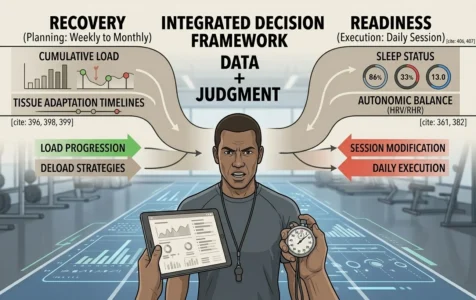
Yes! A practical way to integrate readiness and recovery is to separate planning from execution.
- Planning (weekly to monthly) is guided by recovery metrics.
- Execution (daily) is guided by readiness metrics.
Before modifying a session, the coach should ask:
- Is this a recovery issue or a readiness issue?
- Which system is limiting performance or increasing risk?
- Does today’s session require high readiness to be effective?
This framework prevents overreaction to daily variability while maintaining responsiveness to meaningful signals.
What Are Common Errors in Monitoring Practice?
Several patterns consistently undermine the effectiveness of monitoring systems. Having served in a support role in athletics across both sports medicine and strength and conditioning for 20 years, I have distilled my observations into five situations that cover the vast majority of common errors in player management ranging from youth to professional and international athletics:
- Treating readiness as a proxy for recovery.3
- Reacting to single-day changes rather than trends. A subset of this error is adjusting duration, intensity, volume, etc. because of timing in the season, not any recovery, readiness, or scientific basis.
- Allowing technology to override judgment, especially when a high-trust environment is present.
- Ignoring tissue-specific adaptation timelines or not knowing them in the first place.
- Using monitoring data without explaining decisions to athletes.
I once worked with a coach who stopped lifting and switched two live practices to film sessions at the completion of a very successful regular season to “keep them fresh.” Their performances dropped and the team lost very early in the postseason to a team they had dominated in the regular season. Don’t be afraid to continue what made you successful in the first place. Do not overcorrect or rely too heavily on any single metric. Avoiding these errors requires clarity on purpose. Monitoring exists to support decision-making, not replace it.
How Does One Integrate Data with Coaching Judgment?
The most successful environments do not pit data against intuition. They integrate both, very well. Data provides objectivity, consistency, and early warning signs. Coaching judgment provides context, pattern recognition, and individualized understanding. Readiness and recovery metrics should initiate conversations, not end them. When athletes understand how and why data informs decisions, buy-in increases and compliance improves.
Bringing It All Together
The distinction between recovery and physiological readiness is not merely academic. It is a practical tool for improving training quality, reducing injury risk, and building more resilient athletes.10 Recovery supports adaptation over time. Readiness governs tolerance in the present moment. When coaches understand and respect this distinction, they stop chasing perfect numbers and start making better decisions. Better decisions compound over weeks, months, years, and they shape careers.
Works Cited
- Esco, Michael R., et al. “Monitoring Training Adaptation and Recovery Status in Athletes Using Heart Rate Variability via Mobile Devices: A Narrative Review.” Sensors, vol. 26, no. 1, 2025, p. 3.
- Doherty, Cailbhe, et al. “Readiness, Recovery, and Strain: An Evaluation of Composite Health Scores in Consumer Wearables.” Translational Exercise Biomedicine, vol. 2, no. 2, 2025, pp. 128–144.
- Saw, Anna E., et al. “Monitoring the Athlete Training Response: Subjective Self-Reported Measures Trump Commonly Used Objective Measures.” British Journal of Sports Medicine, vol. 50, no. 5, 2016, pp. 281–291.
- Coyne, Joseph O. C., et al. “The Current State of Subjective Training Load Monitoring: Follow-Up and Future Directions.” Sports Medicine – Open, vol. 8, no. 1, 2022, p. 53.
- Oliveira, Rafael F. S., et al. “The Relationship between Wellness and Training and Match Load in Professional Male Soccer Players.” PLOS ONE, vol. 18, no. 7, 2023, e0289374.
- Impellizzeri, Franco M., et al. “Training Load and Its Role in Injury Prevention, Part I: Back to the Future.” Journal of Athletic Training, vol. 55, no. 9, 2020, pp. 885–892.
- Kalkhoven, Judd T., et al. “Training Load and Injury: Causal Pathways and Future Directions.” Sports Medicine, vol. 51, no. 6, 2021, pp. 1137–1150.
- Gabbett, Tim J. “The Training-Injury Prevention Paradox: Should Athletes Be Training Smarter and Harder?” British Journal of Sports Medicine, vol. 50, no. 5, 2016, pp. 273–280.
- Walsh, Neil P., et al. “Sleep and the Athlete: Narrative Review and 2021 Expert Consensus Recommendations.” British Journal of Sports Medicine, vol. 55, no. 7, 2021, pp. 356–368.
- Cunha, Lucio A., et al. “The Impact of Sleep Interventions on Athletic Performance: A Systematic Review.” Sports Medicine – Open, vol. 9, no. 1, 2023, p. 75.
The post Physiological Readiness vs. Recovery: Part 3 appeared first on SimpliFaster.