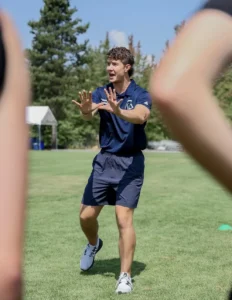

Hello, my name is Cole Hergott, and I like to warm up. A lot. In fact, in my role as Head Strength & Conditioning Coach for the Trinity Western University Spartans, I lead and participate in every warm-up with every group. So, not only do I like to warm up a lot, but I do warm-ups. A LOT.
I’ve estimated that over my time here, I have run and done over 11,000 warm-ups.

With each warm-up taking 8–10 minutes, that leaves me with a whopping 110,000 minutes of warming up, or 1,833 hours.
Does this make me an expert at it? Maybe, maybe not. But I’ll tell you one thing: It has given me ample opportunity to try new things, fail over and over, and develop a system or template that I have found most effective for our setting and context. In our university setting, we often do these warm-ups with groups of 15–45 athletes from various teams, ages 17–26.
Here is the secret.
First things first, why do we warm up? No matter what kind of activity you are doing, whether lifting, sprinting, or playing your sport, you want to make sure you warm up for these two reasons:
- Enhance your performance
- Potentially reduce injury risk
We look for enhanced performance by increasing blood flow to the tissues, increasing range of motion to mimic the ranges you will need in your activity, and increasing neural drive and activity so your motor patterns are crisp and ready to roll. Think of it like starting the car and putting it in drive before you leave, so you just need to press the gas. (Fradkin, et. al 2010)
We look to potentially reduce injury risk by increasing blood flow to the muscles so they are more supple, increasing fluid flow to the tendons and ligaments so they are more pliable, and increasing synovial fluid in the joints so they move more easily. Think of it like adding grease to a rusty car so things move better. (Fradkin, et. al 2010)
So how do we actually do this?
Well, step number one is to get the blood pumping. We do this through dynamic movements.
Jog, backpedal, skip, backward skip, shuffle, carioca, jockey. Simple. We do five there-and-back lengths from sideline to sideline of a basketball court to cover enough distance to get the heart pumping harder, get the athletes breathing more, and ingrain some basic movement and footwork patterns.
I keep this VERY constant throughout the year. We always jog first, and then we skip. Next, we do a shuffle variation, sometimes with a flip at halfway or a flip after every two reps. Then we carioca with a variety of combinations of reps in the front and back. For example, 2-to-1 carioca means two front crosses and one back cross. These are great in early morning sessions to get people thinking. Sometimes we just do crossovers as well. Then we either do a jockey, or hip flips, or gallop, which is a jockey while keeping one leg forward the whole time.
Again, nothing fancy, but the way I see it, this covers basically every movement pattern athletes will use in their sport, so this is our first level of movement proficiency practice.
Then we do something for the arms. Wrist circles, arm circles, rotations. There are endless patterns, but I started consistently adding upper-body movements about two years ago because I wanted to make sure our upper body received the same enhanced blood flow as our lower body. This dynamic portion only takes 2–3 minutes, tops.
Step two of our warm-up is the mobility section. Our hearts are pumping, synovial fluid is lubricating our joints, and now it is time to get limber!

If you just saw the mobility section of our warm-up, you might think I was running a yoga class: upward to downward dog, pigeon, world’s greatest, hip switches, cat-camel. Again, we are not reinventing the wheel. We are just trying to piece together some quality stretches, hold them for 5–10 seconds to unlock some deeper ranges that we will need in the session, and move on.
Some “rules” I follow in this section are:
Make it flow. Each transition should take the least effort possible. We start on our “front” in a push-up position, doing things like upward and downward dog. Then we do pigeon and cat-camel before moving to our butt for hip switches and toe reaches. Finally, we fall to our back for figure-4 and lying T-spine rotations. We don’t go from front to back to front to back. Keep it flowing. I learned a lot about this from doing lots of yoga as an athlete.
Hit the biggest trouble spots for that group. We all know T-spines are locked up, ankles aren’t moving well, and hips just seem to be frozen solid. So work on them. And work on them in various ways. Take the T-spine, for example. It can rotate, flex, and extend. Do all three in a warm-up. Lying T-spine rotations rotate, while cat-camel flexes and extends the spine. The same goes for hips. Don’t just do pigeon and lying figure-4, as both work on external rotation. Do world’s greatest stretch for some hip flexion and extension, and hip switches for internal AND external rotation work. Don’t just “warm up the hips.” Target them in the ways you need to use them. (Ayala, et. al, 2020)
Hit what is needed in that session. If you are doing a max-velocity sprint session, make sure you stretch the hamstrings to their capacity. If you are squatting, work on hip internal and external rotation. If you are hitting an upper-body session, be sure to do extra work on the shoulders. Since we pretty much only do full-body sessions, our warm-ups reflect that. Even if we did an upper-lower split, I think the warm-up is such a good time to get some added mobility work that I probably wouldn’t change what we do anyway.
Left side first. Honestly, it is just a personal preference that my athletes bug me about all the time. But it is just what I do. Left side first. Always. This section takes us another 2–3 minutes.
Okay, now that our blood is flowing and we are feeling as mobile as the day we were born, it is time to “activate” our muscles. Yes, I hate that term, but it kind of fits, so let’s just roll with it.
Basically, activation enhances neural drive to our muscles in specific movement patterns, ensuring proper excitation so those muscles are ready when we need them. As mentioned before, this is us putting the car in drive so that when we go to lift, sprint, or jump, our brains and muscles are ready to respond.
This is where you can get pretty specific to what you are doing. If you are squatting that session, do some bodyweight squats. If you are doing bench press, do some push-ups. Not only does this use the muscles and patterns you will need in your session to enhance performance, but it can also act as a quick diagnostic tool for you and your athletes to assess how they are feeling that day. If bodyweight squats hurt your knees, maybe mention the pain to your coach before slapping weight on the bar and hoping it goes away. The same goes for bench press and push-ups.
As a coach, I deliberately put these movements in our warm-up for this purpose. If we are supposed to squat heavy that day and an athlete comes to me complaining of hip pain, my first response will be, “How did the squats in the warm-up feel?” The athlete’s answer obviously dictates what we do next. But coaches should design the warm-up to prepare athletes for the session, which makes it a great diagnostic for what is to come and whether they can handle it.
If an athlete complains of pain in the warm-up, we know that adding load probably won’t make the pain better, so we are going to make an adjustment for sure. For example, if the squat causes hip pain, we might try a single-leg variation, such as a split squat, to see if that gets rid of the trouble spot. Or we might adjust to a step-up that limits knee and hip flexion if the deep position in the warm-up bothered the athlete. Again, these activation exercises work really well for providing a good assessment right away.
Some common areas that we hit in every warm-up are:
- Abs (planks, leg lowers, flutter kicks, dead bug variations)
- Glutes (glute bridge variations, clamshells)
- Quads (squat patterns, lunges)
- Hips/hamstrings (hinges, single-leg hinges)
- Upper body (push-ups, YTWs)
These movements allow us to activate (sorry) the whole body and get ready to rock and roll!
Activation work adds another 1-2 minutes and is usually sprinkled in among the mobility work to make it flow better.

The last section of our warm-up is the best. Time to get FIRED UP!
Now that we have the blood pumping, improved our mobility, and “activated” the patterns we need, it is time to bridge the gap between the warm-up and the session. We start each training session with some kind of sprint, jump, or throw work to enhance athletic performance and explosive movement while we are freshest, so we need to do something similar to the upcoming work. You see, there is a big difference between going from a bodyweight squat to a max-effort acceleration. To bridge that gap, we basically go back to the start.
We do more dynamic work, but this time it is more intricate. Skip with arm circles, lateral skips, shuffle with sweeps, single-leg butt kickers. These are all more dynamic actions that get the body moving and blood flowing even more. The added complexity also excites the brain and gets the athletes thinking even more, which they will hopefully need to do in the session.
We usually do 1–2 there-and-backs with this added complexity before we throw in a game or challenge. The game can be as simple as a variation of tag or as elaborate as something you see on social media. This is the part where creativity can run free and challenge movement, stability, and competitive spirit. A classic and fan favorite for us is “Bump/Knockout.”
I know lots of coaches who use games in their warm-ups to assess how athletes move without thinking, or they use games to practice the skills needed in the session, such as a tag-and-evade game before an agility session. Yes, I have often used games and challenges for this purpose too. But honestly, I often don’t think that deeply about it. I just pick something that is fun and that the athletes like. Then we do it and move on.
There are some logistical constraints you need to consider when choosing a game to play, such as:
- What equipment do you have access to?
- How many people are in the session?
- How much space do you have?
- How competitive is the group you are working with?
For example, Bump/Knockout is a great one, but if you have a group of 35 athletes who don’t know how to shoot a basketball, it might not be your best choice. Choose something they know how to do, can compete in, and can learn without taking the whole lift session to explain or set up.
Choose the right game, and it will enhance their enjoyment of the warm-up and the session as a whole. That enjoyment is my main goal for the game. I just want the athletes to be excited and smiling when they walk into our weight room after the warm-up, ready to take on the session after their big win or redeem themselves after the loss. So go deep in this area if you want, or just keep it basic and have some fun. Either way, your athletes will love it.
Image 4: Explaining and implementing games for warm-ups are the “secret sauce.”
And then we do one drop squat, and I say, “Let’s giver,” and we all clap at the same time. No joke. I don’t remember where that started, but it is just what we do now. Every time. It is pretty funny to watch the faces of freshmen during their first warm-up: “What kind of cult is this?”
And that is the warm-up. Now, you might be thinking to yourself, “This is oddly similar to the RAMP protocol from the NSCA: Raise, Activate, Mobilize, Potentiate.” You would be right. (Haff & Triplett, 2016) I kind of just flip the A and the M to make it RMAP. It doesn’t roll off the tongue as well…
The bottom line is simple: Warm-ups are vital for an athlete looking to enhance performance in the session and potentially reduce injury risk. But as a coach, you can use the warm-up to build quality movement in your athletes, get them to work on mobility under your watch, and have some fun before they get under the bar or behind the start line.
As mentioned at the beginning, I do every warm-up with my athletes. I lead by example so they can see what the movements look like and how they should perform them. Could I spend my time more effectively by watching their movement and using the warm-up as an assessment? Maybe. I have tried that at times, but I am not willing to give up the buy-in I get from my athletes when they see that the warm-up works because I do it myself and model the right way to do it. Plus, as I tell my athletes, I am ALWAYS warm and ready to rumble, so don’t mess with me!
To paint a fuller picture of my approach, here is an actual example of a warm-up I have done. You might not know what all of these movements are, but hopefully, you can get the gist and apply something similar in your practice if you so desire.
Example
5 there-and-backs: jog, backpedal, skip, backward skip, shuffle x 2, carioca x 2, jockey, backward jockey
Wrist rolls
Arm circles forward, big to small
Arm circles reverse, small to big
Reach up to the sky
Reach down to your toes
Hold your toes and raise your butt up and down three times
Crawl forward to upward dog
Downward dog
Left leg to pigeon
Left foot outside your hand into world’s greatest. Rotate twice.
Downward dog, alternating bending your knees
Right leg to pigeon
Right foot outside your hand into world’s greatest. Rotate twice.
Drop into cat-camel
Alternate reaching under your body (thread the needle)
Walk your hands into your feet, then sit on your butt
Hip switches
Feet together for butterfly stretch
Sit tall and do one arm circle on each side
Drop to your back, place your hands behind your left leg, and pump your leg up and down
Grab your left foot and roll to your side for a quad stretch
T-spine rotations
Roll back to the middle and repeat on the right side (hammy pumps, quad pull, T-spine)
3 dead bugs on each side
5 hip bridges
Sit up with your leg straight and reach for your toes, then open up your chest
Spin around into a push-up position
Shoulder taps and mountain climbers
2 push-ups
Crawl your hands to your feet and stand up
5 squats
3 SL RDLs on each side
Skip with arms to halfway, then butt kickers the rest of the way
SL high knee, switching legs at halfway
Game of rock, paper, scissors where the loser has to turn and run away while the winner has 2–3 steps to tag them
One drop squat (“Let’s giver” *clap*)
Again, over 11,000 of these. Each day has a different warm-up, and I’ve never done the same one for more than a day. That keeps it fresh for me and new for the athletes, while the consistent philosophy and template give us a consistent result. Every. Single. Time. Plus, it’s just fun!
Good luck, coaches.
Peace. Gains.
Cole Hergott
References
Fradkin, A. J., Zazryn, T. R., & Smoliga, J. M. (2010). Effects of warming-up on physical performance: A systematic review with meta-analysis. Journal of Strength and Conditioning Research, 24(1), 140–148.
Ayala, F., et al. (2020). Assessment of the range of movement of the lower limb in sport: Advantages of the ROM-SPORT I battery. International Journal of Environmental Research and Public Health, 17(20), 7606.
Haff, G. G., & Triplett, N. T. (Eds.). (2016). Essentials of Strength Training and Conditioning (4th ed.). Human Kinetics.
The post 11,000 Warm-ups appeared first on SimpliFaster.