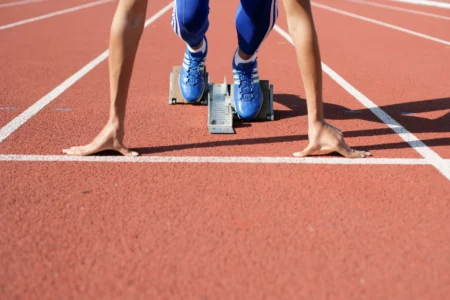

When they asked me to write a piece on using sprint timers to track progress and motivate athletes, they probably didn’t see this coming; and neither did you.
We test our athletes over a three-meter sprint.
No, that was not a typo. THREE-METER SPRINT.
“What the…?” Yeah, let me explain by taking you back a few years.
History (The What and the Why)
I started as the head S&C coach at Trinity Western University in the spring of 2019. Like many coaches who step into an already solidified program, you inherit many things, including some tech. One of the main pieces of tech the previous staff had was a set of Brower timing gates. So that is what I used. I didn’t deliberate between Freelap, Brower, or VALD. They gave me Browers, so I used Browers. End of story.
I really liked them. I had used them previously during my undergrad and as a GA, so I was very familiar with them. I had also used other companies before, and Browers were the most consistent timing gates I had used, for sure. For those of you unfamiliar with them, you can see them below. Nothing fancy, just a good ol’ fashioned laser timing gate system.

Image 1: Brower Timing Gates
Anyway, as I started my job, I knew I wanted to test our athletes’ speed to get good data that actually mattered to the coach and athlete and applied to their sport. So that fall, I started everyone’s training camp with our testing protocol, which included a vertical jump on our force plate and a sprint using the Browers. Most teams did a 20m sprint with a 10m split, while a few others deviated. Volleyball did a 10m sprint because a 20m sprint isn’t applicable at all, and rugby did a 40m sprint because the coaching staff wanted to adhere to what our national governing body, Rugby Canada, did for testing. Rugby Canada tested the 40m sprint, so we tested the 40m sprint. End of discussion.
Testing went well. We retested before Christmas break at the end of November to track progress during the fall semester. I once asked a mentor whether I should test before or after winter break. He told me that if you test before the break, you get to see the progress the athletes made under your watch that semester. If you test them after the break, then yes, there might be more incentive to train and sprint over the break, but more often than not, you will just test which kids actually did something. So I tested before the break. Then, in the spring, we started testing again before our exam break in March or April. But if you’ve been doing the math, you realize this is now the spring of 2020. That meant the world was about to shut down, and everyone would go home for the rest of the spring and summer.
So that was my foray into being the boss and testing athletes’ sprints. It probably sounds very familiar to what most of you do. Test a 10- to 20-meter distance. Reevaluate two to four times per year. Send reports to coaches to show the changes in sprint times. Simple.
Here is where everything gets crazy.
Trinity Western University is a small school. Which means we have a small athletic department. And small facilities. And a small budget to build new facilities. This means our 300 athletes lift out of an old 1,100-square-foot classroom that we have decked out as our varsity weight room. It’s pretty awesome if you ask me, just small.

Image 2: 1,100-square-foot Sparta weight room
Right across the hall from our weight room, Sparta, is our school’s gymnasium. Normal-sized gym, nothing crazy. We would use the gym for all our warm-ups, sprints for lifts, and sprint testing. But over my time at Trinity (I am now in my eighth year), things started to grow. We added more athletes, more kinesiology classes, more students to those classes, more kids’ camps, and more recreation programs. Since there is only one gym on campus, everyone tries to use the same space at what seems like the exact same time. Oh, and in the university’s eyes, who do you think is lowest in the pecking order? The classes and camps that make the school money or the strength & conditioning coach who only costs the school money? Yep, we were at the bottom. That meant I only got to use the gym if no one else was using it. As it turns out, that was not as often as I wanted.
We went from testing a whole team during training camp in August before classes started to testing maybe 30% to 40% of a team because those athletes came to a team lift that happened to give us access to the gym that day. Suddenly, my testing protocol wasn’t as valid and reliable as I wanted, and coaches were frustrated because I couldn’t give them the data they wanted on certain athletes or the team trend.
I had to find a solution. Fast.
No, we couldn’t go outside because moving outside changes the surface. In British Columbia, where we get more rain annually than anywhere else in Canada, is a VERY unreliable place to test.
No, we didn’t have any other space with a good enough surface to reliably test our sprints.
Except one.
You see, with all the added classes and teams and the lack of other options, I realized that the only place I had full control over was Sparta, our 1,100-square-foot classroom. So, I set out to find a suitable way to test sprints WITHIN the four walls of our tiny weight room.
We started with a five-meter distance, placing the Brower timing gates in one corner and having the athletes sprint toward the other corner, which led them out the door. In my mind, sending them out the door was safer than sending them into a squat rack or bench. Five meters was too long, and the athletes didn’t have enough time to slow down safely before they ripped out the door and into the hallway.
So we tried 4 meters. Nope, still a tad too long.
3m? Bingo. Three meters allowed us to sprint the athletes while giving them enough space to stop within the room if they were good decelerators or to move much slower by the time they went into the hall.

Image 3: Setup for the 3m Sprint Test
Now I just had to test it out.
Our men’s soccer team lifted the following Monday, and I knew they would be the perfect guinea pigs for this testing session. So I set up the test and had each athlete try it. I wanted to see how different athletes would perform, how safe the test would be with a bigger group of 25-plus athletes, and what kind of data we would get.
The session was a miracle. No injuries, for one, but the main thing I noticed was the effort. I don’t know about you, but I often dread testing days because most athletes don’t care about testing or want to do it, yet you need to pull full effort out of them. Especially with our 20m sprint, it was like pulling teeth to get them to go a second time, particularly when their first sprint sucked.
That was not the case with the 3m sprint. We had athletes run over 15 trials to try to beat their score or their teammates. Since the test was so quick and non-fatiguing, they were more willing and eager to run it again and again. I had to tell them to stop testing so I could clean up the timers and prepare for the next group. Right then, I knew I had something special.
I went from poor effort in two 20m sprints to max effort across 15 trials. By the way, 15 trials still equal only 45 meters of sprinting versus 40m in my previous protocol (2 x 20m). The athletes also got 15 acceleration and deceleration stimuli, which is a pretty awesome training session. No, not everyone did 15 attempts. I’d say each guy did five or six on average, which is still more than double what I would have gotten before.
After I collected the almost laughable data because everyone’s times were under a second (the team average was around 0.6 seconds), I ranked their 3m scores. I then took the team’s latest 20m testing scores and compared the leaderboards. The leaderboards were over 80% similar. Eight of the top 10 athletes in the 3m also ranked in the top 10 for the 20m, with only one or two changes in placement. Boom. Another sign that we were on to something. Fast is fast. Yes, 3m is very different from 20m, but the athletes who exhibited the ability to accelerate well over 10 or 20m also accelerated better than their teammates over 3m.
Plus, when you really think about sport, how often does a soccer or basketball player sprint 20m all-out? Very rarely.
How often do they blast out for two or three steps and then stop? Much more often. And that goes for pretty much EVERY team sport.
So now this became our “sport-specific” test. All I had to do was pitch it to the sport coaches to get them on board.
At our next staff meeting, I got the chance to present my idea to our coaches. I showed videos of the athletes performing the 3m sprint so the coaches could see that the test was, in fact, safe. I showed them my comparison leaderboard from the soccer team so they could see that the test produced results similar to a longer sprint.
I also explained the sport-specific nature of the test and how it produced the data they wanted to see: who is explosive in a game, not who takes time to build up to something that may never happen. After some really good questions and discussions, the coaches agreed to give the test a go the following season. They were most likely just happy to get some sprint data on their whole team for once.
Long story short, we tested all our teams that fall. Three years later, we still use the 3m sprint.
Final Setup Comments
Our setup is simple. The starting gates sit in the corner of the room at knee height, facing the adjacent corner. The second set of timers sits 3m away at waist height. I place two cones 12 inches behind the starting timers, and athletes must place their lead foot at the cones to start. If the athletes place their feet too close to the timers, they trigger the beam as soon as they twitch. If they start too far back, the test becomes a running start. Roughly 12 inches gives them enough space to get a good push before triggering the beams. I used the same setup for the five-meter and four-meter trials, but Sparta’s corner-to-corner distance is closer to 10m, so we needed more space to decelerate and less space to accelerate. Hence, the same setup produced more success over the 3m distance.
I let athletes have as many trials as they want. Some do two. Some do 15, as already mentioned. Yes, athletes who run more experience some warm-up effect, but I am all about giving kids the optimal conditions to be at their best. If they want to run more, I don’t want to deter them. You might choose to limit athletes to three or four attempts, but I don’t. Sorry. Rest is arbitrary. After they run, they just get back in line. Or they go do another Sparta Score test first and come back. No set time, just natural flow.
Some Quick Troubleshooting Notes
- Make sure athletes start with their toes at the cones and don’t sneak back. Starting farther back will give them lower scores without making them faster.
- Watch their arms at the finish because some athletes will reach forward. I’ve had to disqualify a record a few times because of that.
- Make sure athletes start in a two-point stance, not a three-point stance or a massively bent-over position. Otherwise, their hands will trigger the beam early, and their score will suck.
- Make sure they wear shoes. The things we have to enforce these days…
- Cue them to run THROUGH the timers. It’s only two or three steps, so slowing before the finish is less of an issue than usual. Oh, and cue full effort too. Again, the things you have to do…
Now (The How and the When)
Let me give you a glimpse into how we run our testing now. No secrets, doors wide open to Sparta for this one.
Our teams test three or four times each season. My goal is to test them during training camp to assess their summer progress. We then test again before winter break to assess the progress we’ve made during the semester, as mentioned earlier. Then we test a few weeks after the break. No, I don’t use this test to see how their winter training went. Most of our teams start playoffs in February, and I don’t want to mess around during that time, so I schedule their third test session for the end of January to see where we are heading into crunch time. Then we go into playoffs and win (sometimes). I also try to get some testing done before the athletes head off for summer break. This past year, I had an optional testing session for anyone who wanted to get data before the break. I had about 20 athletes show up. Hence, the three-to-four range.
Our testing protocol consists of:
- Vertical jump on force plates
- 3m sprint
- Squat, bench, and chin-up velocity tests
And that is it. All our team sports have a fitness test component they also complete during training camp and maybe after winter break, but that testing isn’t as frequent. Five metrics, and we have tracked them religiously for three straight years.

Image 4: The 3m sprint test has revolutionized our testing protocol
Sparta Score
While not the main focus of this article, I want to tie everything together and explain a bit more about what I do with the data. Those five metrics became increasingly valuable to track over time as we collected more data. I learned what good and bad scores were (the first year involved a lot of shoulder shrugging when athletes would ask, “Is that good?”), what progress should look like, and the differences between sports and genders.
But there were still issues, as there always are.
You see, with those five metrics, someone very rarely improved or declined in all five. So let’s take an example from an athlete’s testing.
Fall Testing
CMJ: 42 cm
3m: 0.65 sec
Squat Velocity: 1.02 m/s
Bench Velocity: 0.88 m/s
Chin-Up Velocity: 0.69 m/s
Winter Testing
CMJ: 44 cm
3m: 0.67 sec
Squat Velocity: 0.99 m/s
Bench Velocity: 0.93 m/s
Chin-Up Velocity: 0.72 m/s
You can see that this athlete jumped higher, benched faster, and performed a chin-up faster. But the athlete sprinted slower, and their squat velocity decreased.
Did they improve or not?
I constantly had this conversation with coaches and athletes. I would often stick with the team averages to show overall progress, which is much easier. But when looking at individuals and their scores, determining whether our work is effective becomes tough.
Enter the Sparta Score.
I’m hoping most of you are familiar with Boyd Epley. He was basically the first strength & conditioning coach at a university (Nebraska). I had spoken to Boyd before and knew that while at Nebraska, his staff came up with a “Husker Power Score,” which combined all their testing data into one succinct number. I looked it up and asked Boyd about it. To my dismay, it was not a simple equation, and we did not perform most of the Nebraska tests here in Sparta. So I took to the whiteboard and tried to come up with something on my own. I tried a few different equations until I found the golden ticket:
CMJ (in meters) + Squat Vel (m/s) + Bench Vel (m/s) + Chin-Up Vel (m/s) – 3m time (in sec) = SPARTA SCORE.
This way, the better your individual scores are, the better your overall score becomes. Higher scores in the first four tests add more to the Sparta Score, while a faster sprint time subtracts less.
So if we take the example above…
Fall Testing
CMJ: 42 cm
3m: 0.65 sec
Squat Velocity: 1.02 m/s
Bench Velocity: 0.88 m/s
Chin-Up Velocity: 0.69 m/s
0.42 + 1.02 + 0.88 + 0.69 – 0.65 = 2.36
Winter Testing
CMJ: 44 cm
3m: 0.67 sec
Squat Velocity: 0.99 m/s
Bench Velocity: 0.93 m/s
Chin-Up Velocity: 0.72 m/s
0.44 + 0.99 + 0.93 + 0.72 – 0.67 = 2.41
Based on our Sparta Score, I would conclude that this athlete got physically better from fall to winter.
“Yeah but their sprint…” Nope. Don’t overcomplicate it. The way I pitch it to my athletes is this:
If your Sparta Score got better, you got better.
And
If you have a higher Sparta Score, you are just better. Plain and simple. That one gets the competitive juices GOING!
And just like that, our testing days have gone from teeth-pulling sagas to full-blown competition days that everyone gets excited about. We have top-20 leaderboards for males and females, a top 10 for each component of the score, and a one-of-a-kind keychain that the leader gets until someone beats them. Epic stuff.
No more confusion from coaches. No more missed tests. No more frustrating testing days.
That is how the 3m sprint ties into our overall testing protocol, and we can complete the whole thing within our tiny weight room.
Limitations
While it might seem like I am saying the three-meter sprint is the greatest thing to ever happen to testing, it’s not. The Sparta Score is! The three-meter sprint has lots of limitations:
- There is no research on the 3m sprint. Trust me, I looked. There is no historical data or previous tests or scores to compare our population against, except our own data now that we have three years of it.
- No one else is doing the test for me to compare against either. It is strictly an “in-house” test that our athletes talk about, but it sounds crazy when they ask athletes from other schools, “Hey, how fast is your 3m sprint?”
- The test is very short, and the data changes are very small. Since the test is so short, all the data, as mentioned, is under one second. But the shorter the test, the less room there is for progress. For example, over the last three years, we have seen some athletes make “big progress” by going from 0.63 seconds to 0.58 seconds. That is pretty good if you think about extrapolating the progress over 10 or 20 meters, but right now, the biggest impacts of that small change are increased confidence and a 0.05 boost to the athlete’s Sparta Score.
- With the small scores, there are also smaller differences between athletes. For example, some of our slowest male athletes run around 0.7 seconds, while the school record is 0.49 seconds. An athlete broke that record during the optional testing day this spring, becoming the only athlete to go under half a second. So we have smaller improvements and smaller differences between athletes. But again, now that we have three years of data and tracking, the test is still valuable for us!
- Lastly, with these small scores, I have not calculated a smallest worthwhile change (SWC). While that might be proper and official, in my setting, I am all about creating confidence and making people better. So when a kid who has been busting their butt for me goes from 0.68 to 0.67 and is overjoyed, more than because I told them “67,” who am I to say, “Well, actually, this doesn’t prove you are legitimately faster until your score is…” Give me a break. Did you score more goals or points than the other team? Then you won. Did your time go down? Then you are faster. Yeah, I know this mindset is going to rub some people the wrong way, but I’d much rather inspire and build people up through my words and deeds than have them hate me because I am a snob. Sorry.
Conclusion
Some coaches have commented that I would be better off just doing a broad jump, as the distance is pretty close. While I agree the broad jump is valuable (our rugby and hockey teams have it as an added test to track as well), the difference is that it is not a sprint. I want sprint data, and this test is what I have come up with. Is it perfect? No. Does it work well for us? You bet. And that is just going to have to be good enough for me until we get a bigger space. Honestly, even then, I might keep it. It’s gained too much traction now, and I like it too much!
So am I a genius or an idiot? That is up to you to decide. But regardless of what you think, this is my story, and I’m sticking to it!
Good luck coaches.
Peace. Gains.
Cole Hergott
References
Duthie, Pyne, Ross, Livingstone, & Hooper (2006). The reliability of ten-meter sprint time using different starting techniques. Journal of Strength and Conditioning Research, 20(2), 246–251.
Oliver & Meyers (2009). Reliability and generality of measures of acceleration, planned agility, and reactive agility. International Journal of Sports Physiology and Performance, 4(3), 345–354.
Lockie, R. G., Murphy, A. J., Knight, T. J., & Janse de Jonge, X. A. K. (2011). Factors that differentiate acceleration ability in field sport athletes. Journal of Strength and Conditioning Research, 25(10), 2704–2714.
Goods, P. S. R., Appleby, B., Scott, B. R., Peeling, P., & Galna, B. (2024). High-intensity running during international male field hockey involves frequent changes of direction and repeated accelerations but seldom reaches sprint velocities. Journal of Strength and Conditioning Research, 38(11), 1933–1940.
The post The Most Unusual Sprint Test. Ever. appeared first on SimpliFaster.