
A Six-Step Feedback Workflow for Coaches
Coaches do not need more clips. They need a reliable way to decide what matters, what the footage actually supports, and what to change next.
Case note: The tennis example in this article transparently combines recurring review patterns. It demonstrates a coaching decision process; the article does not present it as a controlled case study.
The clip is not the decision
A normal training session can leave a coach with forty clips and no clear answer. The phone has done its job. It captured the serve, the first two steps, the landing, the swing, and the recovery. Then the athlete asks the question that matters: “What should I change?”
That is where video review often breaks down. A coach can freeze the contact frame, draw lines, compare angles, and produce a page of numbers. None of that guarantees a useful intervention. More visible detail can simply produce more commentary.
A practical review has a harder standard: it must improve the next coaching decision. What does the clip show? What does it not establish? Which observation matters now? What cue or task will test that judgment in the next block?

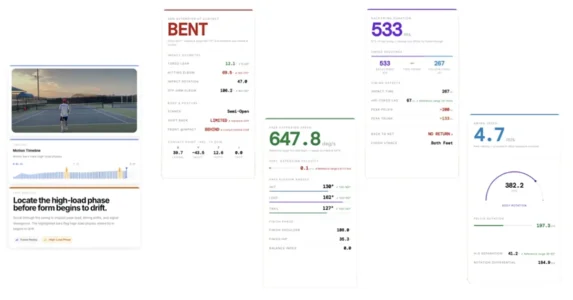
Figure 1. The problem can begin before the frame that attracts the coach’s attention. A movement timeline keeps preparation, load, contact, and recovery in sequence. Original visual © Nous Technology Limited.
Figure context: All five visuals in this article are illustrative interface concepts, analytical workflows, and example motion-data outputs from the SpatialForm development prototype. Recurring movement-review patterns, rather than an identified athlete case, inform the visuals.
Research on augmented feedback supports the value of visual information, but the delivery matters. Attentional focus, feedback frequency, and the athlete’s control over when the athlete receives feedback can influence whether feedback supports learning or merely creates short-term correction.[1–6]
The workflow below is deliberately narrow. It does not ask video to diagnose the athlete. It asks video to make the coach’s reasoning clearer.
This workflow grew out of repeated product testing and review sessions during SpatialForm’s development. The sessions paired ordinary phone video of tennis movement with interface prototypes and coaching-oriented questions about timing, contact, recovery, and the next action. The recurring problem was not a shortage of clips or metrics; it was deciding which visible event should change the next repetition, separating that observation from a causal explanation, and preserving the comparison for the next review.
A forehand that looked like an arm problem
Consider a right-handed intermediate player in a cross-court live-ball drill. Several forehands arrive late. Some float short; one or two are struck cleanly; others crowd the body. The contact frame is striking: the hitting arm is markedly bent, the contact point sits behind the body’s center, and the finish does not flow into a quick return to the court.
The tempting cue is obvious: “Extend your arm.” It may also be the wrong first decision.
When the coach reviews the sequence instead of the contact frame alone, the picture changes. Racket preparation remains small until the final approach step. The pelvis and trunk peaks cluster close to impact. The player reaches contact while still organizing the swing, then waits for the finish to settle before recovering. The bent arm is real evidence. It is not yet the explanation.

Figure 2. A bent arm and a contact point behind the center of mass are observable. The clip alone does not establish why they occurred or which correction should come first. Original visual © Nous Technology Limited.
The coach chooses a timing intervention rather than a body-part correction. The cue is: “Show the back fence before the ball crosses the service line.” The coach feeds the next six-ball block at roughly seventy percent pace from the same position. The camera stays fixed. The coach watches only three events: start of preparation, contact space, and first recovery step.
In the composite follow-up block, preparation moves earlier in four of six repetitions. Contact is less crowded in those four. Recovery is still late. That result is useful because it narrows the next decision. The coach keeps the preparation cue for one more block and leaves recovery for a separate task instead of stacking a second instruction on top of the first.
Video did not reveal a hidden truth. It helped the coach avoid solving the last frame before checking where the sequence first went off schedule.
1. Write down what the footage proves
The coach should write the first note in language that another coach could verify from the clip. “The first recovery step begins after the finish pauses” is an observation. “The athlete is lazy out of the shot” is an interpretation. “The pelvis stopped because the glutes are weak” is a causal claim that the video cannot establish by itself.
Numbers do not remove this distinction. An elbow angle, a knee-extension speed, or a hip–torso separation value can describe the recorded movement with useful precision. None of those numbers can tell the coach why that movement occurred, whether it was harmful, or whether changing it should be the priority today.
Evidence vs. Inference: A Practical Coaching Table
| The video supports | The video does not establish | A better coaching question |
|---|---|---|
| The hitting arm is bent at contact. | That the arm position is the primary technical fault, or that weakness caused it. | Did the sequence leave enough time and space for contact? |
| Contact occurs behind the body’s center. | Poor anticipation, fear, or a visual-processing problem. | When did preparation begin in the cleaner repetitions? |
| Knee-extension speed is high. | That push-off was effective for the task. | Where did that output occur, and what movement effect followed? |
| The first recovery step begins after the finish pauses. | Low effort or poor motivation. | Which constraint would make re-entry part of the shot? |
A good evidence note contains an event, a time or position, and a comparison: “In four of six forehands, preparation begins after the ball crosses the service line; in the two cleaner repetitions, it begins earlier.” That sentence is modest. It is also coachable.
2. Find the earliest event that changes the decision
Coaches often say they are looking for the root cause. A single phone video rarely proves one. A more useful target is the earliest observable event that changes what the coach will do next.
In the forehand example, the crowded contact frame is downstream. The sequence has already lost time before impact. If the coach starts with arm extension, the athlete may straighten the arm without gaining preparation time or contact space. Starting earlier in the chain gives the next repetition a cleaner question: does earlier organization change the contact that follows?

Figure 3. Timing values become useful when they organize a coaching question: where did the sequence begin to compress, and what will the next repetition test? Original visual © Nous Technology Limited.
This step should end with a working hypothesis, not a verdict. “If preparation begins earlier, contact may move farther from the body and recovery may start sooner.” The next block tests that sentence. If the predicted response does not appear, the hypothesis changes.
3. Strip away data that does not change practice
A polished dashboard can be a trap. Coaches are naturally drawn to the largest number, the red warning, or the most dramatic frame. The useful variable is not the one that looks most scientific. It is the one that changes the next coaching choice.
A high knee-extension speed, for example, may coexist with very little vertical displacement. Strong hip–torso separation may coexist with poor timing or a late recovery. Those are not contradictions. They are reminders that isolated outputs do not describe the whole task.

Figure 4. A large lower-body output can coexist with another weak signal. Coaches should not mistake isolated numbers for a complete explanation of the task. Original visual © Nous Technology Limited.
Use three filters. First, does the feature appear across more than one representative repetition? Second, does it occur early enough to influence the phase you care about? Third, can the athlete explore it through a cue, a constraint, or a change in task design? If the answer is no, the data may be interesting, but it is not yet the coaching priority.

Figure 5. Strong rotational values may still sit inside a poorly timed or poorly recovered action. Context decides whether a metric changes practice. Original visual © Nous Technology Limited.
4. Compare like with like
A comparison is only as good as the conditions around it. A new camera angle, a different feed, a tired athlete, or a changed drill can make the second clip look different without showing a meaningful adaptation.
Standardization does not require a laboratory. Keep the camera in roughly the same place. Capture the same phase of the task. Mark the same events. In tennis, those events might be feed release, first movement, start of preparation, contact, first recovery step, and court re-entry. In acceleration, they might be first movement, the first four contacts, trunk rise, and the first timing gate.
The aim is not to make practice artificial. It is to prevent the coach from mistaking a new view for a new athlete.
5. Coach one thing, then build a repetition that can answer it
“Prepare earlier” is not a complete intervention. It names a preference but gives the athlete no task to solve. “Show the back fence before the ball crosses the service line” gives timing a visible target. The coach can then adjust the feed speed, rally pattern, or court marker so the next repetition gives that target a fair test.
Whenever possible, the cue should point toward the movement effect or the task environment rather than asking the athlete to consciously arrange several body parts. Meta-analytic evidence generally favors an external attentional focus for motor performance and learning, although the wording still has to fit the athlete, the task, and the stage of learning.[2]
Judge the quality of a cue by the response it produces, not by how biomechanically impressive it sounds. If the athlete becomes rigid, loses the ball, or starts monitoring every joint, the cue is too expensive. Shorten it, move attention outward, or change the task.
6. Review the response, not just the outcome
The ball can land in and the intended movement can remain unchanged. The ball can miss while the athlete produces the timing the coach asked for. That is why the next review must return to the same narrow question.
Keep one representative clip from before the intervention, one from after, and a short note recording the cue and task constraint. Then decide among three options: keep the feedback because the intended response is appearing; fade it because the athlete can now regulate the action; or change it because the predicted response did not appear.
More feedback is not automatically better. Studies of moderate-frequency, bandwidth, and self-controlled feedback suggest that useful schedules often leave room for the athlete to attempt, estimate, and request information rather than receiving a correction after every trial.[3–6] The evidence is not a license to hand every decision to the athlete, and coach-controlled comparisons remain an important limitation in this literature. The practical point is simpler: do not interrupt a useful search process merely because another clip is available.
A workable rhythm is one review, three or four uninterrupted attempts, then another review only when the athlete requests it or when performance moves outside an agreed range.
Two quick transfer examples
Sprint acceleration. The video shows that the athlete’s trunk rises sharply between the second and fourth contacts. It does not prove weak hip extensors or poor intent. The coach chooses one testable priority: maintain projection through four contacts. The next block uses four 10-meter accelerations from the same start, with full recovery and a fixed side-on camera. A cone just beyond the fourth contact and the cue “push the track behind you until the cone” give the athlete a clear task. Review stays narrow: does trunk rise occur later while the time to the first gate stays stable? The coach does not score every joint angle.
Change of direction. The video shows that the penultimate step is short and the athlete enters the cut upright. It does not prove a strength deficit. The coach widens the approach, marks the penultimate contact, and uses the cue “arrive low before the line.” The coach judges the next block by entry posture, contact placement, and exit direction. If those change without loss of speed, the task has answered the coaching question.
A six-line note is enough
A coach does not need a long report after every session. Six lines will preserve the reasoning:
- Context: athlete, task, intensity, and representative clip.
- Evidence: what the footage directly shows.
- Inference: the current explanation, clearly labeled as a hypothesis.
- Precision: the one feature that matters for the next block.
- Intervention: the cue and the task constraint.
- Response: what changed, what did not, and whether to keep, fade, or change the feedback.
That note turns video from an archive into a record of coaching choices. It also makes collaboration easier. Another coach can see what the first coach observed and assumed, and why the first coach chose the next drill.
The point of video is the next rep
The best video review is not the one with the most overlays. It is the one that leaves the coach and athlete with a better question and a more informative repetition.
Start with what the footage can support. Find the earliest event that changes the decision. Ignore data that does not alter practice. Compare the same task under comparable conditions. Coach one thing. Then check whether the athlete produced the response you intended.
The aim is not to win an argument with the frame. It is to make the next rep more useful than the last.
References
- Sigrist R, Rauter G, Riener R, Wolf P. Augmented visual, auditory, haptic, and multimodal feedback in motor learning: a review. Psychonomic Bulletin & Review. 2013;20(1):21–53. doi:10.3758/s13423-012-0333-8.
- Chua L-K, Jimenez-Diaz J, Lewthwaite R, Kim T, Wulf G. Superiority of external attentional focus for motor performance and learning: systematic reviews and meta-analyses. Psychological Bulletin. 2021;147(6):618–645. doi:10.1037/bul0000335.
- Hebert EP, Coker C. Optimizing feedback frequency in motor learning: self-controlled and moderate-frequency knowledge of results enhance skill acquisition. Perceptual and Motor Skills. 2021;128(5):2381–2397. doi:10.1177/00315125211036413.
- Agethen M, Krause D. Effects of bandwidth feedback on the automatization of an arm movement sequence. Human Movement Science. 2016;45:71–83. doi:10.1016/j.humov.2015.11.005.
- Post PG, Aiken CA, Laughlin DD, Fairbrother JT. Self-control over combined video feedback and modeling facilitates motor learning. Human Movement Science. 2016;47:49–59. doi:10.1016/j.humov.2016.01.014.
- van der Meer BR, van den Hoven MAC, van der Kamp J, Savelsbergh GJP. Self-controlled video feedback facilitates the learning of tactical skills in tennis. Research Quarterly for Exercise and Sport. 2024;95(2):537–545. doi:10.1080/02701367.2023.2275801.
- Sollie O, Holmsen K, Steinbo C, Ommundsen Y, Losnegard T. Observational vs coaching feedback on non-dominant whole-body motor skill performance: application to technique training. Scandinavian Journal of Medicine & Science in Sports. 2021;31(11):2103–2114. doi:10.1111/sms.14030.
The post From Video to the Next Rep appeared first on SimpliFaster.