By: Kosta Telegadas
M.S.Ed, CSCS, XPS, XFS
Introduction: Why Hamstring Injuries Refuse to Disappear
Despite advances in sports science and monitoring technology, hamstring injuries remain one of the most common soft-tissue injuries in sport. Hamstring strains are among the most disruptive injuries across intermittent sports. Soccer, rugby, American football, track and field, basketball, and tennis all show the same trend. Hamstrings account for a significant percentage of missed training days, and once an athlete sustains a strain, the likelihood of reinjury increases dramatically. Even with advances in GPS tracking, sprint load management, and improved strength programming, hamstring injury rates have not dropped as much as most practitioners expected since the increased use of technology in sports.
The problem is not that programs neglect posterior chain development. Most athletes already perform Romanian deadlifts and glute bridges. The real issue is specificity of the distal hamstrings. Most of these exercises, such as the RDL and glute bridge, train the hamstrings primarily as hip extensors. Yet most hamstring injuries occur during sprinting, when the muscle is lengthening under load while decelerating knee extension. That disconnect between training stimulus and the mechanism of injury creates a vulnerability gap.
So, the question is: “How do we fix this?” The answer is not as complex as coaches think. This is where the Nordic curl comes into play. This specific leg curl variation exists to close that gap by exposing the hamstrings to long-length eccentric loading in a way that closely mirrors a good portion of sprint demands.
What Is a Nordic Curl?
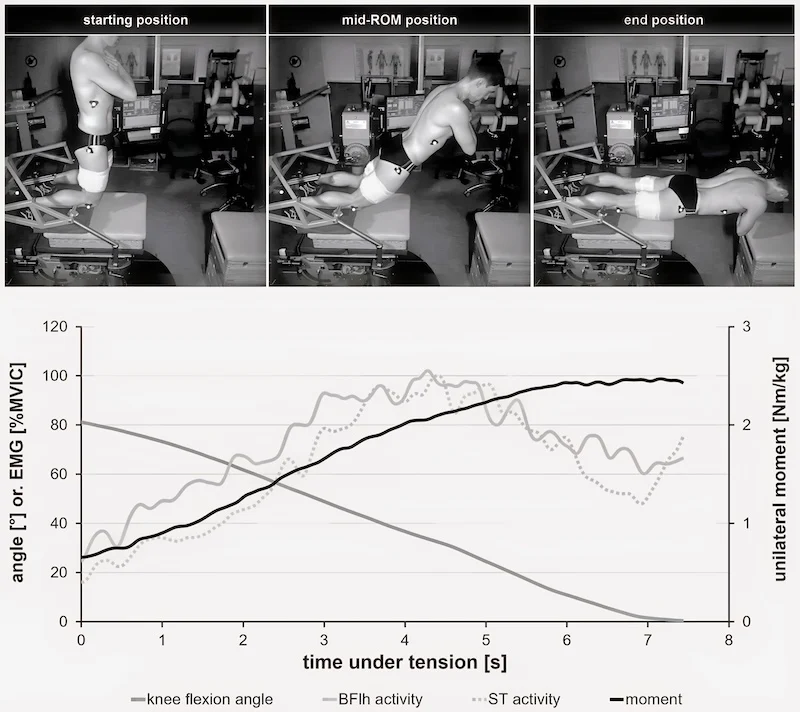
The Nordic curl, often referred to as the Nordic hamstring curl, is a kneeling eccentric knee flexion exercise where the athlete lowers their torso toward the ground while maintaining full hip extension. A partner, strap, or machine secures the ankles, and the athlete resists gravity as long as possible before catching themselves with their hands. On the surface, the movement looks simple. It produces extremely high eccentric forces and places heavy demand on the biceps femoris and surrounding hamstring musculature, developing the hamstring and deceleration capabilities critical to athletics.
What separates Nordic curls from traditional hamstring exercises is how they load the tissue. I’ve found most posterior chain movements emphasize hip extension or short-range knee flexion. The Nordic curl shifts the stress to eccentric knee flexion at long muscle lengths while keeping the hips locked out. This loading pattern closely reflects how the hamstrings function during the terminal swing phase of sprinting. During this phase of movement, the hamstrings act primarily as brakes rather than movers. Because of this braking function, Nordic curls are not just another accessory lift. They are a direct intervention for sprint-related injuries and tissue resilience.
Sprint Mechanics and the Hamstring Injury Mechanism
During maximal velocity sprinting, the swing leg accelerates forward rapidly. The knee extends aggressively, and just before foot contact, the hamstrings fire eccentrically to slow the limb and stabilize the joint for ground strike. This phase, commonly known as the “terminal swing,” is where most hamstring injuries occur. At this moment, the muscle is lengthening, producing high force, and operating at extreme velocities simultaneously.
Traditional strength training rarely challenges the hamstrings under these same conditions. Romanian deadlifts load the muscle heavily but primarily through hip extension. Machine leg curls (specifically lying and standing) isolate knee flexion but without long-length eccentric stress. Yes, coaches can use eccentrics on machine leg curl variations, but those variations still do not compare to the Nordic curl outside the seated hamstring leg curl. More work needs to be done to determine whether the seated hamstring curl can truly replicate the same results as the Nordic leg curl. Nordic curls bridge this gap by reproducing the lengthened, higher-force eccentric demand experienced during sprinting. Over time, this specific exposure improves the hamstrings’ ability to tolerate stretch under load, enhancing sprint durability rather than relying on generalized strength improvements.
The Research: Why Nordic Curls Reduce Hamstring Injuries by 50 Percent
Research on Nordic hamstring training has consistently shown meaningful reductions in hamstring injury rates. In one of the most influential studies, Petersen et al. (2011) conducted a large cluster-randomized controlled trial in male soccer players and reported that teams implementing a progressive Nordic hamstring exercise program experienced significantly fewer new hamstring injuries compared with control groups. Follow-up work by van der Horst et al. (2015) produced similar findings in amateur soccer players, showing that regular inclusion of Nordic hamstring exercises during training reduced hamstring injury incidence across a competitive season. Together, these studies helped establish the Nordic hamstring exercise as one of the most evidence-supported interventions for improving hamstring resilience in athletic populations. A large systematic review and meta-analysis by van Dyk et al. (2019) confirmed these trends across more than 8,000 athletes, showing that programs including Nordic hamstring exercises reduced hamstring injury rates by roughly 50%. See the quote below or look at all the research in the references section of this article for yourself!
“Subsequent meta-analyses have reinforced these findings, showing that training programs incorporating Nordic hamstring exercises can reduce hamstring injury risk by roughly 50% across multiple sports and competitive levels.” – van Dyk, N., Behan, F. P., & Whiteley, R. (2019)
Why Nordic Curls Work: The Physiology
Nordic curls drive several adaptations that directly improve hamstring resilience. First, they significantly increase eccentric knee flexion strength. This enhances the hamstrings’ ability to absorb force during the terminal swing of the running gait, improving braking capacity when sprinting at high speeds. These are not general strength gains. They are highly specific to running mechanics.
Second, Nordic curls increase biceps femoris fascicle length. Longer fascicles allow muscle fibers to operate across greater ranges of motion, improving force production at extended lengths and reducing strain during rapid elongation. Third, repeated eccentric exposure improves neuromuscular coordination, refining timing and stiffness regulation during high-speed movement. When combined, these changes remodel both muscle structure and neural control. Athletes are not just stronger. Their tissue behaves differently under stress.
Nordic Curl Progressions: From Beginner to Advanced
Most athletes cannot perform a strict Nordic curl on day one, and that’s okay. Below are some progressions that coaches can implement to ensure proper adaptation and progression.
Early phases often begin with isometric holds, where athletes lean forward slightly and maintain position for several seconds to build positional tolerance. From there, band-assisted Nordics allow controlled eccentrics while reducing load. Athletes then move to eccentric-only repetitions, partial range control, and eventually full-range Nordics.
Advanced variations may include tempo eccentrics and external loading with plates or vests to put more strain on the hamstrings. Control and intent should always drive progression, not ego. The goal is not just to complete repetitions but to maintain hip extension while resisting gravity through the hamstrings.
| Progression Stage | Exercise Variation | Primary Goal | Coaching Notes | Typical Prescription |
|---|---|---|---|---|
| Stage 1 | Isometric Nordic Hold | Build positional tolerance and hamstring tension at long muscle lengths | Athlete leans slightly forward while maintaining hip extension and neutral spine. | 3–4 sets × 10–20 sec holds |
| Stage 2 | Banded/Assisted Nordic Curl | Introduce controlled eccentric loading with reduced resistance | Bands or counter load is anchored to a rack or machine reduce load during descent | 3–4 sets × 4–6 reps |
| Stage 3 | Eccentric-Only Nordic Curl | Develop eccentric hamstring strength at long muscle lengths | Athlete lowers under control and pushes back to start using hands | 3–4 sets × 3–5 reps |
| Stage 4 | Full Range Nordic Curl | Achieve full eccentric control through the entire movement | Athlete lowers under control and lightly catches with hands | 3–5 sets × 3–6 reps |
| Stage 5 | Weighted Nordic Curl | Maximize eccentric overload and advanced hamstring strength | Weight vest or plate held at chest while maintaining full hip extension | 3–5 sets × 3–5 reps |
Coach’s Note: I intentionally did not include partial Nordic curls in this progression. In my experience, athletes often compensate during partial reps by hinging at the hips or shortening the lever to make the movement easier. When that happens, the hamstrings are not exposed to the same level of eccentric stress that makes Nordic curls effective. For this reason, I prefer progressing athletes from assisted Nordics to controlled eccentrics and eventually full-range Nordics while maintaining proper hip extension and tension throughout the movement. Some coaches might disagree with me, but I have found this to be the case with most athletes.
Technical Execution and Common Errors
Proper setup is critical when I coach the Nordic curl. I have athletes kneel on a padded surface with their ankles firmly anchored, hips fully extended, spine neutral, and core braced. From this position, I cue them to lower slowly while maintaining a straight line from the knees to the head, resisting gravity for as long as possible before catching themselves with their hands.
The most common mistakes I see are athletes breaking at the hips, excessively arching the lower back, free-falling into the bottom position, or having inconsistent ankle anchoring. These compensations shift stress away from the hamstrings and reduce the effectiveness of the exercise. A simple cue I often use is “fall like a plank,” which usually cleans up technique quickly. Early on, coaching attention matters. In my experience, poor execution quickly turns the Nordic curl into something else entirely.
Equipment Options
Athletes can perform Nordic curls with partners, straps, or dedicated machines. Partner holds are the simplest option and work well in team environments, though resistance can vary depending on stability. Strap systems anchored to racks provide a consistent setup and allow athletes to train independently.
I’ve personally used dedicated Nordic machines that offer adjustable resistance and safer progression, which can improve compliance in larger programs. Modified GHD setups can also work for assisted variations, although the mechanics differ slightly. Regardless of setup, consistency matters more than equipment. The best system is the one athletes will actually use week after week.
Programming Nordic Curls
In my programming, Nordic curls typically appear two times per week during offseason development phases. I use moderate volumes and emphasize slow, controlled eccentrics during this period. As preseason approaches and sprint volumes increase, I typically reduce the frequency to around once to twice per week. During the competitive season, I usually maintain Nordic curls once per week at lower volumes to preserve the adaptations without creating excessive soreness on the hamstrings.
I have found that Nordic curls integrate well either after the warm-up before sprinting sessions or as accessory work following lower-body lifts. Try to avoid programming high Nordic volumes too close to maximal velocity sprint days. The goal of this movement is to maintain consistent exposure to the exercise across the year rather than relying on aggressive blocks that often lead to soreness and reduced athlete buy-in. See the chart below for my programming:
Macrocycle Programming for Nordics
| Training Phase | Weekly Frequency | Volume | Programming Emphasis | Placement in Session | Coaching Notes |
|---|---|---|---|---|---|
| Offseason | 1-2× per week | Moderate (3–4 sets × 5-8 reps) | Controlled eccentrics and progressive strength development | After warm-up before sprint work or after lower-body lifts in the weight room | Focus on building eccentric strength and tissue capacity |
| Preseason | 1-2× per week (depending on volume of soreness and fatigue) | Moderate (3 sets × 3–5 reps) | Maintain eccentric strength while sprint volumes increase | Often placed after warm-up or early in the session | Avoid excessive soreness as speed work increases |
| In Season | 1× per week | Low (2–3 sets × 3–4 reps) | Maintain adaptations and fascicle length | Typically, after lifts or low neural demand days | Keep volumes low to prevent soreness and protect performance |
Coach’s Note: While Nordic curls are a valuable exercise for developing eccentric hamstring strength, I do not rely on them exclusively. In my programming, I often rotate other hamstring exercises such as Romanian deadlifts, razor curls, hip thrust variations, leg curl machines, or even slider leg curls alongside Nordics. Rotating exercises helps distribute training stress across the posterior chain while preventing excessive soreness or mental fatigue from repeatedly performing the same demanding movement. The goal is to maintain the benefits of Nordic curls while using complementary exercises to keep athletes fresh, engaged, and progressing throughout the training year. In simple terms: we just want to prevent burnout and keep changing variations throughout the year if able.
Youth vs. Elite Athletes
When I work with youth athletes, I prefer to introduce Nordic curls early through assisted variations and isometric holds. At this stage, my main focus is teaching proper positioning and preparing the hamstrings to tolerate tension at longer muscle lengths rather than pushing maximal loading. In most cases, one or two sessions per week is enough to build foundational resilience and improve movement literacy.
In the United States especially, youth athletes often face demanding competition schedules. Many athletes participate in AAU or travel programs that require frequent tournaments, long weekends of competition, and extended travel. Athletes commonly play multiple games in a single day across several consecutive days, which significantly increases sprint exposure and fatigue. Considering this, I believe early hamstring preparation should not only be wanted but needed for all youth athletes. Even simple Nordic variations can help expose the tissue to controlled eccentric stress before athletes accumulate large sprint volumes through competition. Early hamstring preparation leads to fewer acute and major injuries.
With more tenured or elite athletes, my approach becomes more individualized. Programming needs to account for sprint volumes, competition schedules, injury history, and re-conditioning levels needed prior to season. Rather than cycling Nordic curls in and out of the program, I prefer to maintain year-round exposure at appropriate doses. In my experience, this consistent exposure helps preserve fascicle length and eccentric hamstring strength, which are key factors in protecting athletes against the high-speed running demands they face throughout the season.
Tactical Athlete Considerations
In my current role working with tactical populations, I see firsthand how different the training environment can be compared to traditional sport settings. Tactical athletes face unique challenges including load carriage, irregular recovery, unpredictable schedules, and elevated levels of operational stress. These factors can increase injury risk while also limiting available structured training time. Because of this, exercises that deliver a high return with minimal equipment become extremely valuable.
Nordic curls are one of the movements I often prioritize in these environments because they require very little setup and can be implemented anywhere, whether in a firehouse, police department, or a military unit deployed overseas. In my experience, a common approach is to include one to two Nordic sessions per week during structured training cycles while reducing volume during periods when operational demands increase. If these tactical athletes are highly fatigued and Nordics cannot be done that day, I will substitute with a lying or standing leg curl machine or regress the Nordic variation used.
I also like pairing Nordic curls with deceleration and sprint mechanics work to better reflect the movement demands tactical athletes encounter in the field. This combination helps reinforce hamstring resilience while improving an athlete’s ability to control high-speed movement. The goal is to build durability without adding unnecessary fatigue in an already demanding training environment.
Nordic Curl Alternatives
Some athletes need preparatory work before progressing to full Nordics. Razor curls, eccentric slider leg curls, long lever bridges, and Romanian deadlifts all help develop posterior chain capacity. I have often found these movements are valuable early on or during rehabilitation.
None of these alternatives replicate the long-length eccentric knee flexion demands of Nordic curls. They are bridges, not replacements. Check out the charts below to see great alternatives and “bridges” that I use to build up athletes’ hamstrings with alternative methods to the Nordic curl.
Preparatory Hamstring Exercises Before Nordic Curls
| Exercise | Primary Focus | Why It Helps | Typical Use |
|---|---|---|---|
| Razor Curl | Knee flexion with hip extension | Develops coordinated hamstring activation through a larger range of motion | Early progression or intermediate strength work |
| Eccentric Slider Leg Curl | Controlled eccentric knee flexion | Teaches athletes to resist knee extension under load | Early hamstring eccentric preparation |
| Long Lever Glute Bridge | Posterior chain isometric strength | Strengthens hamstrings at longer muscle lengths while maintaining hip extension | Early-stage tissue preparation |
| Romanian Deadlift | Hip extension strength | Develops overall posterior chain capacity and hamstring strength | Foundational strength development |
Progression Toward Nordic Curl Loading
| Stage | Exercise Focus | Goal |
|---|---|---|
| Stage 1 | Foundational posterior chain strength (RDLs, bridges) | Develop general hamstring strength |
| Stage 2 | Controlled knee flexion eccentrics (slider curls, razor curls) | Introducing eccentric hamstring loading |
| Stage 3 | Assisted Nordic variations | Build tolerance to long-length eccentric stress |
| Stage 4 | Full Nordic curls | Develop maximal eccentric hamstring strength |
| Stage 5 | Weighted Nordic curls | Advanced overload and sprint durability |
Return-to-Play Integration
After a hamstring injury, coaches should reintroduce Nordic curls gradually. The athletes and sports med staff that I’ve worked with in the past typically start with isometric holds, then assisted eccentrics, partial range control, and eventually full-range variations. Coaches add external loading once tissue tolerance improves.
Once the sports medicine team clears the athlete, combine Nordics with progressive sprint exposure, deceleration training, and hip extension strength work. A complete return-to-play strategy rebuilds both tissue capacity and movement confidence under speed. Nordic curls are one piece of that puzzle, but a critical one. Our entire S&C staff cannot handle these undertakings alone. They typically rely on an athletic trainer, physiotherapist, and even a surgeon if necessary. Make sure to build up and consult with your team as needed!
Conclusion
Over the years of coaching athletes across different environments, I have consistently found the Nordic curl to be one of the most effective tools for building resilient hamstrings. While it may appear simple, the exercise exposes the hamstrings to the exact type of eccentric stress that occurs during sprinting. When programmed correctly and progressed appropriately, it helps close the gap between traditional strength training and the real mechanical demands athletes face on the field. In my experience, athletes who develop the ability to control their body through a full Nordic curl build a level of posterior chain durability that carries directly into sprinting, deceleration, and high-speed movement.
At the same time, I do not view Nordic curls as a standalone solution. Effective hamstring development still requires a balanced program that includes sprint exposure, hip extension strength, and complementary posterior chain exercises. What I have found, however, is that when Nordic curls are consistently included throughout the year, athletes tend to tolerate higher running loads and experience fewer soft tissue setbacks. For coaches looking to improve hamstring durability, the Nordic curl remains one of the simplest and most evidence-supported interventions we can implement.
If you have any questions or want to talk about strength and conditioning, coaching, or business, feel free to reach out to me!
You can email me at:
CoachKostaTelegadas@gmail.com or connect with me on Instagram @Coach_Telegadas. Now get out there and get those hamstrings built up for the season!
References
Petersen, J., Thorborg, K., Nielsen, M. B., Budtz-Jørgensen, E., & Hölmich, P. (2011). Preventive effect of eccentric training on acute hamstring injuries in men’s soccer: A cluster-randomized controlled trial. The American Journal of Sports Medicine, 39(11), 2296–2303. https://doi.org/10.1177/0363546511419277
van der Horst, N., Smits, D. W., Petersen, J., Goedhart, E. A., & Backx, F. J. G. (2015). The preventive effect of the Nordic hamstring exercise on hamstring injuries in amateur soccer players: A randomized controlled trial. The American Journal of Sports Medicine, 43(6), 1316–1323. https://doi.org/10.1177/0363546515574057
van Dyk, N., Behan, F. P., & Whiteley, R. (2019). Including the Nordic hamstring exercise in injury prevention programs halves the rate of hamstring injuries: A systematic review and meta-analysis of 8459 athletes. British Journal of Sports Medicine, 53(21), 1362–1370. https://doi.org/10.1136/bjsports-2018-100045
The post Nordic Curls: The Complete Guide to the Most Effective Hamstring Exercise for Athletes appeared first on SimpliFaster.