Introduction
In the last decade, sport performance technology has definitely exploded in popularity and availability. Coaches (and athletes) now have seamless access to force plates, GPS, timing systems, VBT devices, wearable fitness tools and AMS platforms that rival what professional teams and lab settings used to invest hundreds of thousands into. Now, it’s more affordable than ever and anyone can get similar, if not the same, technology in whatever setting they coach in.
The landscape is exciting… but also confusing for many.
With so many options, the question is no longer, “What tech is available?” Now it’s more like, “What tech do I actually need?”
With so many options, the question is no longer, “What tech is available?” Now it’s more like, “What tech do I actually need?” says @JustinOchoa317
Share on X
The purpose of this article is to cut through the noise. Instead of reviewing individual brands or features, I’ll zoom out and examine the categories of technology that modern coaches rely on. This will help coaches determine what’s worth their time, money and coaching bandwidth. And quite honestly, once you figure out which categories fit you best, the team at SimpliFaster has the experience and expertise to help you narrow your search down to brand-specific conversations.
This is a practitioner-first, honest framework for building a tech stack that fits your environment, your workflow and your athletes.
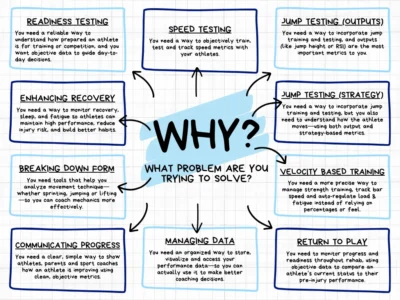
Start With This Question: What Problem Are You Trying to Solve?

Image: As a coach looking to purchase new technology, always start with ‘what’ and ‘why.’ What problem are you trying to solve, and why does that help you be a more effective coach or help your athletes perform better or stay healthy? Once you know the answer to these questions, figuring out what tech solves these problems becomes much easier.
Sports performance tech is only valuable if it solves a real coaching problem. It has to fill a void. If it doesn’t serve as a solution or fill a void, then it has to be a value-add to the program that doesn’t impede on the efficiency of the organization as it currently runs without tech.
Many coaches purchase a tool and then try to find a way to use it. Most of my personal tech purchases have come after several weeks to months (sometimes years) of research, demos, trials and planning of exactly what my program will look like when I implement it.
I am a self-employed entrepreneur so my lens is skewed towards that but even in the team setting with a wide range of budgets and, in some cases, a ridiculous amount of expendable resources, I feel that a thorough research period is necessary.
Sports performance tech is only valuable if it solves a real coaching problem. It has to fill a void, says @JustinOchoa317
Share on X
So, what problem are you trying to solve with tech?
Some very common problems coaches try to solve include:
- Improving speed or vertical jump
- Readiness testing with athletes
- Monitoring asymmetries or injury risk
- Auto-regulating programming
- Auto-regulating strength loads
- Showing progress to sport coaches or athletes
- Tracking changes over time
- Optimizing RTP progressions
- Communicating more effectively with athletes or staff
Once you identify your problem(s), the necessary tech becomes more obvious.
If you’re using the iPhone stopwatch to time sprints and you need a reliable & accurate way to test sprints, you obviously need a timing system.
If you want to track jump metrics, you have the option of manual vertical jump testing, jump mat testing or force plate testing. Do you care about outputs only? Manual testing will work just fine. Are strategies important to you? Get a jump mat or force plates. Is jump efficiency something you need to track? You definitely need force plates. From there your environment and budget will point you in the right direction.
Just for one more solid example, if you need a way to monitor and manage all of your training data then an athlete management system (AMS) would be a great tool. From there, you can again rely on your environment & budget to find the right AMS. How many athletes do you work with? How much data do you need to store? Do you need a programming tool within your AMS? Do you need API integrations?
Here’s the key… Your workflow must come first.
The tech supports the system, not the other way around.
Tech is not going to fix an unorganized program. Tech is not going to make up for poor programming. Tech is not going to replace your need to thoughtfully coach every rep & set. But when you have a solid system in place tech can absolutely enhance it, and even fix some of the chinks in the armor you may not have every noticed.
Here’s the key… Your workflow must come first. The tech supports the system, not the other way around. Tech is not going to fix an unorganized program, says @JustinOchoa317
Share on X
The 5 Core Categories of the Modern Tech Stack

Image: Graphic of the 5 core categories coaches are looking to use technology to track or to improve: managing data, how to get faster, how to jump higher, how to lift smarter and get stronger, and how to recover better.
Once you understand the problem you’re trying to solve, the next step is to identify which outcome category the solution belongs to. Instead of thinking in terms of individual tools or brands, it’s far more effective to think in terms of the result you want to create for your athletes.
Almost every piece of performance technology fits neatly into one of five outcome-driven buckets:
- Run Faster
- Jump Higher
- Lift Smarter
- Recover Better
- Manage Data
This framework keeps the decision-making process simple, helps you avoid unnecessary purchases and protects your coaching bandwidth. Below is a deeper dive into each category—what it solves, the types of tools that support it, and how coaches can implement those tools in meaningful ways.
Run Faster
Tech that improves sprint performance, increases speed exposure and enhances the feedback loop for athletes and coaches relevant to speed.
Speed is one of the most objective, measurable and transferable athletic qualities you can train. Whether you work in the private sector or team setting, every athlete benefits from getting faster. Speed increases are more than just about physical qualities, there are also great neurological benefits and safety residuals as well.
Technology in this category is built to help you replace subjective timing with reliable, high-quality information. The foundational tools here are timing systems built around a few common technologies like infrared lasers or RFID magnetic fields.
These systems allow coaches to accurately measure acceleration segments, maximum velocity exposure, multidirectional speed & agility, and even some of the technical qualities of a sprint through timing distributions.
The main value of this technology is clarity. Instead of relying on a coach’s stopwatch or “that looked faster,” you now have precise data that shows whether an athlete is improving, stagnating or fatiguing.
Objective sprint data also enhances competition in training. When athletes see their times (or their teammates’ times), they naturally raise their intent, which alone can increase performance outputs. It also helps coaches create better training progressions. You can differentiate between acceleration days, max-velocity days, tempo days or mixed-method sessions based on the actual outputs you’re capturing.
Objective sprint data also enhances competition in training. When athletes see their times (or their teammates’ times), they naturally raise their intent, says @JustinOchoa317
Share on X
A secondary layer of “Run Faster” technology includes variable resistance/assistance sprint devices, video analysis tools and GPS tracking. These allow coaches to bridge the gap between quantitative and qualitative analysis without abandoning the actual training effects from the tech itself.
GPS is probably the most common of those listed and can definitely be useful in the same ways that timing systems are, but may be a better fit for the “Manage Data” category based on the fact that timing systems are often more affordable and accessible than GPS if the sole goal is just getting speeds and times on reps.
Timing tells you what happened, but video and movement analysis often tell you why it happened. Or help you coach it on a deeper level. Variable resistance/assistance speed devices have popped onto the scene and kind of combine all of these variables into one training device. Together, they give athletes a much richer understanding of their mechanics and help coaches build individualized programs that improve both the physical and technical qualities of speed.
Ultimately, tech in this category solves one major problem: The need to measure speed with accuracy and consistency. If “run faster” is a priority in your program, this category should be one of the first you invest in.
Notable options include:
- Freelap
- Dashr
- Brower
- OVR Sprint
- Sportreact
- 1080 Sprint
- T-Apex
- PlayerData
- Catapult
- Kinexon
- FiyrPod
Jump Higher
Tech that monitors jump performance, assesses jump strategy and/or helps evaluate fatigue, asymmetry and readiness.
Jump testing is one of the longest-standing staples in sport performance. Historically, coaches have used simple tools like manual measurement devices or chalk-on-wall jumps to measure vertical jump height.
While the outcome (height) is valuable, modern sport science has evolved to give coaches access to far more detailed information. In this category, you’ll find force plates, jump mats, contact grids and sensor-based devices that evaluate vertical displacement, reactive strength, jump strategy, force production and many other important metrics.
Tools in the “Jump Higher” category help coaches understand jump data at whatever level is most appropriate for them. Again, it comes down to what problem are you trying to solve and what information do you need out of the solution.
Tools like jump mats, contact grids and wearable accelerometers allow coaches to get jump height and maybe some low-hanging fruit auxiliary metrics like flight time, ground contact time and reactive strength index. These are largely outcome-based metrics with a small amount of strategy & efficiency sprinkled in,
Force plates or 3D camera systems, on the other hand, can allow you to get a much more robust level of data out of every jump, as well as bring that same tracking into other areas of training like training, rehab, return-to-play or even sport-specific usage.
Most notably, force plates can focus on more than just the ground-level data that a jump mat would give. Metrics like countermovement depth, modified RSI, power, impulse (braking or propulsive), force production, asymmetry and literally hundreds more are at your finer tips. This tier of jump testing equipment gives you the full spectrum of outcomes, strategies and efficiency.
The versatility of jump testing makes it a cornerstone for many programs. It can be used for weekly readiness monitoring, return-to-play assessments or simply tracking long-term development.
The beauty of the category is that you can scale it to your environment. And it can grow with your career. When I first started training, I only cared about outputs because that’s all I was really knowledgeable on. As I grew as a coach and continually invested in my education and enhancing my skill set, I learned that there is far more to jumps than just the height and invested in jump mats and then eventually force plates.
Bottom line: If you want to help your athletes jump higher, more efficiently or learn the ins-and-outs of their jump performance, this is the category for you.
Notable options include:
- Hawkin Dynamics
- VALD
- Skyhook
- Plyo Mat
- OVR Jump
The versatility of jump testing makes it a cornerstone for many programs. It can be used for weekly readiness monitoring, return-to-play assessments or simply tracking long-term development, says @JustinOchoa317
Share on X
Lift Smarter
Tech that enhances strength training intent, precision, programming and technique.
Strength training is foundational to every performance program, and technology can dramatically improve how coaches prescribe, monitor and progress it. The “Lift Smarter” category is centered around velocity-based training (VBT) tools, bar-speed sensors, power measurement systems and rep-quality trackers.
I must admit, this is my favorite category and the one that I probably have the most bias towards. Specifically to VBT. I think that VBT is the most impactful tech that I have implemented throughout the course of my career. I started using VBT back in 2017, before I ever got jump mats, force plates, an AMS or really any other tech that I use now. And even after adding all of those things after VBT, I still think it’s the tech that I use the most, get the most out of and feel like my athletes respond the best to.
These devices help coaches understand how an athlete is performing in real time, not just how much they’re lifting. Similar to force plates, it allows coaches to understand some elements of strategy and efficiency, rather than just the final outcome of the lift.
The biggest advantage of VBT is auto-regulation and program management. Instead of prescribing loads solely based on percentages or estimated 1RMs, coaches can adjust loads based on how fast the athlete is moving the bar. This ensures the intended training stimulus is actually being delivered.
Another major benefit is that VBT increases intent. When athletes see their velocities rep-to-rep, they naturally try harder, especially when given target velocity zones or velocity cutoff zones. If an athlete can train with good intent consistently over time, that is a really good recipe for success and both intent and consistency are benefits of VBT implementation.
Beyond VBT, tools in this category can also help coaches profile athletes—identifying whether they are force-dominant, velocity-dominant, or somewhere in the middle. This allows for individualized programming that aligns with each athlete’s needs and gives the coach the opportunity to create fine-tuned individualized plans.
Finally, “Lift Smarter” tech creates a more objective record of strength progress. Instead of relying solely on rep maxes or load increases, coaches can track improvements in speed at submaximal loads, power output changes over time, relative to bodyweight force/power outputs and movement efficiency or technique within the lift.
At its core, this category solves the problem of training quality, precision and fatigue management in the weight room.
Notable options include:
- Vitruve
- GymAware
- Tendo
- Perch
- Enode
- OVR VBT
- Elite Form
VBT increases intent. When athletes see their velocities rep-to-rep, they naturally try harder, especially when given target velocity zones or velocity cutoff zones, says @JustinOchoa317
Share on X
Recover Better
Tech that supports sleep quality, regeneration, tissue capacity, fatigue assessment and recovery education for athletes.
Recovery is where adaptation happens and technology that enhances recovery is often underrated because it lives behind the scenes. This may not be directly in every coach or program’s tech stack, but it’s still something that we can offer. That said, if we don’t offer it, we should still be educated enough on it to recommend it to our athletes.
This category covers sleep trackers, HRV and heart rate tools, wearable readiness sensors, soft-tissue devices, pneumatic compression tools, cold/heat therapy tools and recovery monitoring platforms. The aim is to help athletes understand how behaviors, workloads and stress impact their ability to adapt to training.
The most practical recovery tools for coaches are trend-based systems—such as those that monitor heart rate variability, sleep consistency, sleep duration and nighttime physiological markers. These help identify when an athlete may be under-recovered or responding poorly to training stress.
Importantly, recovery tech should never dictate training decisions on its own; its real value is promoting awareness and education. When athletes see how alcohol, poor sleep habits, late-night meals or stress impact their physiology, they naturally begin building better habits.
Another important layer includes modalities like compression therapy, vibration devices and cold/heat exposure tools. While these do not directly make athletes “stronger” or “faster,” they help manage soreness, promote circulation and create recovery routines that athletes actually follow.
These tools are especially useful in team settings or high-volume environments where recovery turnaround time matters. At the high-performance level, recovery tech also plays a role in long-term load management.
When combined with data from sprinting or jump testing, recovery tools allow coaches to triangulate signals of fatigue and make informed decisions. In the simplest terms, this category solves one problem: help athletes feel better, adapt better and sustain higher levels of performance over time.
Notable options include:
- Hyperice
- Normatec
- Firefly Recovery
- B Strong Bloodflow Restriction
- Therabody
- Oura Ring
- Whoop Band
- Polar
- Garmin
- Game Ready
- My FItness Pal
Recovery tech should never dictate training decisions on its own… When athletes see how alcohol, poor sleep habits, late-night meals or stress impact their physiology, they naturally begin building better habits, says @JustinOchoa317
Share on X
Manage Data
Tech that organizes, stores, visualizes and programs your training workflow across an entire athlete/coach system.
Data without organization is just noise. The “Manage Data” category includes athlete management systems (AMS), dashboard‐building tools, automated reporting platforms, cloud‐based storage systems, integrated data pipelines and program-writing software that allows you to design, deliver, and monitor training programs across your athlete roster.
The primary purpose of this category is to centralize everything: your testing data, your training prescriptions, your program progress, your athlete readiness/wellness logs and your communications with athletes/coaches.
When all of these functions live in a single system (or are tightly integrated), you can visualize trends, track long‐term development, identify red flags and communicate insights much more clearly with athletes, sport coaches, medical staff and parents.
Program writing software is a key piece of this puzzle. Tools that allow you to build libraries of exercises, assemble custom workouts, assign them to individuals or groups, track execution/feedback, and link the training prescription to athlete data are really impactful.
For example, platforms exist that let you load an exercise library, drag & drop training blocks, assign to athletes based on readiness or phase, monitor adherence and adjust as necessary.
This type of software helps you move training off paper and spreadsheets and into a workflow that supports decision making and accountability.
That said, you don’t always need the most advanced AMS or program‐writing tool right away. Many coaches (especially in private settings) function exceptionally well with well-designed spreadsheet systems or simple software that covers just the program writing + logging piece. Plus, those coaches need a post-of-sales (POS) and scheduling solution too.
The technology should match the complexity of your environment. If you’re tracking 5‐10 athletes and only doing periodic testing, a full enterprise AMS might be overkill. But if you’re managing multiple teams, athletes in different phases, with multiple data streams, then this category becomes critical.
Ultimately, the goal of “Manage Data” is not simply to collect more data or write prettier programs—it’s to make the data you already have more actionable, more interpretable, more valuable, and to build training programs that respond intelligently to that data.
If you find yourself spending more time hunting spreadsheets, duplicating efforts or wondering which athlete did which session or how that session tied to readiness, you need better tools in this category.
Notable options include:
- TeamBuildr
- Vitruve Hub
- Rock Daisy
- TrainHeroic
- Lumin Sports
- Universal Speed Rating
- CoachMePlus
Data without organization is just noise, says @JustinOchoa317
Share on X
How to Choose the Right Tech for Your Environment
The next step is figuring out what actually fits your environment. This is where many coaches get stuck—not because they don’t understand the tools, but because they haven’t taken inventory of what they really need to solve.
Before you invest in anything, walk through the following questions:
1. Who do you train, and how many of them?
2. How often do you [want to] test or monitor your athletes’ data?
3. Which metrics matter most right now?
4. What’s your realistic budget?
5. If you buy this tool today, what will it change tomorrow?
So, for a personal example of what led me to upgrading from jump mats to force plates, here is how my thought process went. This was the internal dialogue I had with myself as well as some of the conversations that I had with various sales reps throughout the process.
1. Who do you train, and how many of them?
I train primarily professional basketball players during the offseason, anywhere between 30-40 on a weekly basis. Most athletes come 3 times per week, some come up to 5 times per week. We train both on the court and in the weight room.
2. How often do you [want to] test or monitor your athletes’ data?
I currently use a jump mat to test jumps twice per week. Once focused on jump height, another time focused on RSI. However, I still use the mat daily and in every session to drive intent of plyos, jumps or custom drills. I would like to continue doing so if possible.
3. Which metrics matter most right now?
Right now I have access to jump height, ground contact time and RSI. However, I am noticing that subjective readiness markers are not always in line with the objective measurements that I can capture with my current equipment. Also, I am not able to dissect technique or movement strategies with my current equipment. I feel that with this population, the most important metrics to me are those strategy and efficiency-based metrics that I can’t get with jump mats.
4. What’s your realistic budget?
At this time, I would rather not pay a lump sum of money for a piece of equipment because technology is evolving so quickly. I would rather pay a subscription or finance fee with the opportunity to upgrade hardware or software if I feel like I need to at any point. Similar to an iPhone. This also helps with my budgeting because I can build it into my monthly expenses. My goal is to keep this investment to under $400/mo.
5. If you buy this tool today, what will it change tomorrow?
If I get force plates, I will be able to do 3 main things immediately. First, I will be able to get data points on my athletes that show me their movement strategies and efficiency, something that I am not able to get with jump mats. Secondly, I will be able to communicate more fluidly with my athletes’ team staff because every professional team staff has force plates. This will allow us to share data and keep continuity for the athlete year around. Third, I will be able to customize my programming even more uniquely to the athlete based on more in-depth testing that I’ll be able to do with them.
This workflow made it obvious that force plates were the right move for me to invest in without any doubt and then I was able to confidently take demos with brands to find the best fit for my program. I already knew what I wanted and needed, then it was just about finding the right company to provide the solution.

Image: The three tiers of technology, with the base (tier 1) having the necessities and the tip of the tier pyramid (tier 3) having niche, but premium, tools that accentuate a program that’s already self-sustaining.
After working with a wide range of tech over the years, I think it’s helpful to break things down into a simple tier system.
Every environment is unique, but generally speaking, here’s where I believe most coaches get the best value.
Tier 1 — Must-Have, High-ROI Tools
These deliver value in every setting and improve the quality of training immediately.
- A sprint timing system (Run Faster)
- A VBT device or bar-speed tool (Lift Smarter)
- Jump mats or force plates (Jump Higher)
I would consider these the essentials because they have the highest ROI in training and testing scenarios. These will directly impact your athletes daily when you implement them because it’s a part of the training process, offers testing solutions and often time will have some form of data organization built-in.
Tier 2 — Environment-Dependent Tools
These tools become extremely valuable if your environment supports frequent use, consistent monitoring or higher-level demands.
- A structured data & programming workflow (Manage Data)
- GPS or wearable monitoring (Run Faster / Manage Data)
- Recovery tools and readiness trackers (Recover Better)
If you have the bandwidth to use them consistently, they elevate your entire system. These can make your tier 1 efforts even more efficient and impactful. But in some scenarios, they may not be necessary or beneficial from a cost or time investment perspective.
Tier 3 — Nice-to-Have Tools
These can be helpful… like really helpful, but typically only after the essentials are in place.
- Premium recovery & wellness tools
- Lab-level analytics and integrated testing systems
- Niche devices that solve highly specific problems
These are luxuries, not necessities, and should only be added once the core of your tech stack is functioning smoothly. A strong tech ecosystem doesn’t start at Tier 3, although these may be the most flashy & popular items. It starts at Tier 1 and grows intentionally from there.
Closing Thoughts: Clarity, Not Confusion
At its core, the purpose of technology in sport performance is simple: make good coaching easier and make athlete development clearer.
Tech does not replace coaching. It does not replace communication. It does not replace relationships or the art of training.
What it does is amplify the impact of a well-built system. When you start with the outcomes you want—run faster, jump higher, lift smarter, recover better, manage data—the decision-making process becomes straightforward.
You no longer chase gadgets. You no longer feel pressured to “keep up.” You simply build a tech stack that supports your workflow, your philosophy and your athletes.
Start small. Use what you buy. Track consistently. Let the data inform your decisions, not control them. And when you’re ready to scale, add tools that enhance your system.
If you do that, your tech won’t just collect numbers. It will elevate your entire coaching environment.
At its core, the purpose of technology in sport performance is simple: make good coaching easier and make athlete development clearer, says @JustinOchoa317
Share on X
The post The Modern Performance Coach’s Tech Stack appeared first on SimpliFaster.